This is default featured slide 1 title

Go to Blogger edit html and find these sentences.Now replace these sentences with your own descriptions.This theme is Bloggerized by Lasantha Bandara - Premiumbloggertemplates.com.

This is default featured slide 2 title

Go to Blogger edit html and find these sentences.Now replace these sentences with your own descriptions.This theme is Bloggerized by Lasantha Bandara - Premiumbloggertemplates.com.

This is default featured slide 3 title

Go to Blogger edit html and find these sentences.Now replace these sentences with your own descriptions.This theme is Bloggerized by Lasantha Bandara - Premiumbloggertemplates.com.

This is default featured slide 4 title

Go to Blogger edit html and find these sentences.Now replace these sentences with your own descriptions.This theme is Bloggerized by Lasantha Bandara - Premiumbloggertemplates.com.

This is default featured slide 5 title

Go to Blogger edit html and find these sentences.Now replace these sentences with your own descriptions.This theme is Bloggerized by Lasantha Bandara - Premiumbloggertemplates.com.

Tuesday, February 1, 2022

UK researcher who pioneered faith-based project to tackle cervical cancer has expanded her work to the national level


By Alicia Gregory and Ben Corwin
University of Kentucky

The best solutions begin when you listen to the people whose problems you’re trying to solve. That community-based focus — the crux of what Nancy Schoenberg says is her approach as a medical anthropologist — has been a guiding value through her 25 years at the University of Kentucky.

“We are not the experts. The experts are the people we are talking to, so we need to listen to people," said Schoenberg, UK's Marion Pearsall Professor of Behavioral Science. "We need to honor that what they say is important in their lives, and why they do and don't do things. And once we do that, then we can work with them to come up with evidence-based solutions.

“As an anthropologist in the College of Medicine, initially, I think a lot of people did not exactly understand what kind of work I was doing. But when evidence starts to emerge, when I start to get more and more funding, when I start to disseminate my work, start to train students, people start to understand what translational science is — taking existing interventions and making sure they work in a community setting.

“For generations, there has been a tendency on the part of outsiders to pathologize Appalachia,” Schoenberg said. “Too often, even those with good intentions tend to see the region as nothing other than a complex of problems. What typically gets left out of the picture are the tremendous assets the region possesses.”

Chief among those assets is a strong sense of shared cultural identity and community, Schoenberg says. It led to the creation of “Faith Moves Mountains,” a faith-based outreach program that has tackled cervical cancer screening, diabetes treatment and prevention, smoking cessation, and healthy eating and physical activity in Appalachian communities, through churches, since 2004.

“It’s an approach that has been employed extensively and with great success in African-American communities,” Schoenberg said. “But there wasn’t much data out there on faith-based interventions in predominantly white, rural populations. Faith Moves Mountains changed that.”

Since 2009, Schoenberg has served as principal investigator on more than $10.8 million in sponsored grants and contracts. She currently leads a mobile-health research project, based on an intervention designed at Northwestern University, that targets healthy lifestyle choices.

“To our knowledge it’s the first randomized control trial of an mHealth technology-oriented intervention in Appalachian Kentucky," she said. "And our goal for that project is to try to increase fruit and vegetable intake, to increase physical activity, and to decrease screen time. We know that using technology may be a really good substitute for what’s not available in their local communities.”

The impact of her work and the recognition of its importance is evidenced by Schoenberg’s many collaborators at UK. “People’s doors are open. And that is a hallmark of UK, is our sense of collaboration, our sense of mission, our responsibility, and respect for the land grant,” she said.

In 2021, Schoenberg and Mark Dignan, a professor in the College of Medicine’s Department of Internal Medicine, received $764,000 from the National Cancer Institute for a project called Addressing Rural Cancer Inequities through Scientific Excellence (ARISE) to train 10 postdoctoral researchers to address cancer-related health disparities in Appalachian Kentucky.

Schoenberg’s goal to train a diverse future workforce of clinicians and scientists is evidenced in her many roles: director of the Center for Health Equity Transformation (established in 2018 to enhance innovative, transdisciplinary and impactful research and training to improve the health of vulnerable Kentucky residents), co-developer and director of the Research Scholars Program (established in 2021 to ensure diversity and inclusion in research by promoting faculty success), associate vice president for research in research professional development, and associate director at the Center for Clinical and Translational Sciences.

“Studies have shown, time and time again, that the most creative, most impactful, most frequently cited publications are those from diverse research teams," she said. "So one trend that I am very encouraged by, but recognize we need to go a lot further, is making sure that all people are at the table — people from all backgrounds, all walks of life. Because we need their talent, and we need their input, and it just improves our science tremendously.”

Schoenberg recently accepted an invitation to serve on the leadership team of the Rural Policy Research Institute, an organization that provides nonpartisan, research-based analysis on needs and opportunities facing rural communities to help policymakers understand the rural impacts of public policies. In the past three months, she has given three national talks at the National Institutes of Health, the University of Iowa and, upcoming, at Washington University in St. Louis.

“It’s an honor for me to be able to represent UK nationally,” Schoenberg said. “And it’s gratifying to see our work in communities making an impact inside and outside of the commonwealth.”
Monday, January 31, 2022

Kentucky's weekly Covid-19 case numbers and positive-test rate are on the decline, offering hope for the weeks to come

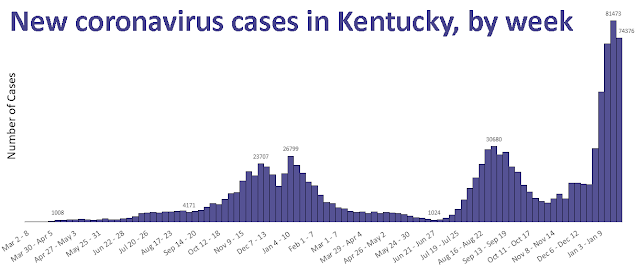
State Dept. for Public Health graph, adapted by Ky. Health News; for a larger version, click on it.

By Melissa Patrick

Kentucky Health News

Kentucky got a hopeful Covid-19 report from Gov. Andy Beshear at his weekly pandemic press conference, with the state's weekly coronavirus case numbers and positive-test rate on the decline. 

"We certainly hope that between these two points of data, total cases and positivity rate, that we are headed in the right direction," he said. 

Since Saturday, Kentucky reported 19,915 new coronavirus cases, bringing the seven-day rolling average to 10,946, 11 percent below Friday's. Of Monday's 4,950 new cases, nearly 25% are in people 18 and younger. 

Kentucky reported 74,376 new cases in the Monday-to-Sunday reporting week ended Jan. 30, down from 81,473 the prior week, but still higher than two weeks ago, when the state reported 72,165 cases. 

"We hope what we are seeing is a cresting and hopefully the beginning of the downward slope in Omicron cases," Beshear said. 

That said, he cautioned that case numbers are still too high, noting that last week's case number was the second highest and more than double the peak during the Delta surge. 

Other good news is that the weekly positivity rate, which is a leading indicator, has also gone down, and is lower than it was two weeks ago.

The share of Kentuckians testing positive for the virus in the last seven days is 28.49%, a rate that has slowly decreased since a high of 33.1% on Jan. 23.

The bad news is that hospitalizations are still going up on a weekly basis and are close to the high seen during the Delta surge. The hope, Beshear said, is that they will soon start coming down and the question is, "When and how much longer will our hospitals be pushed to the brink?" 

Kentucky hospitals reported 2,413 Covid-19 patients Monday, with 454 in intensive care and 232 on mechanical ventilation. The total was 40 fewer than Friday, but it often drops on Monday, Beshear noted.

Nine of the state's 10 hospital regions continue to use at least 80% of their intensive-care beds, with four over 90%. Northern Kentucky is again at 100%. 

Beshear reiterated that Kentuckians should get a Covid-19 vaccine and booster shots, pointing to an article in The New York Times that breaks down Centers for Disease Control and Prevention research that shows how getting vaccinated -- and boosted -- offers significant protection from dying from Covid-19. David Leonhardt wrote: "That risk is not zero, but it is not far from it." 

The data shows that the average weekly chance of a boosted person dying of Covid was about one in a million during October and November, compared to about 2.4 per million of dying in a car crash or about three per million of dying from the flu or pneumonia, reports the Times. 

"While the vaccine provides incredible protection, the booster shot provides even more,"Beshear said. "In fact, deaths of those that have gotten a booster is almost zero. Look, people are are dying because of the lack of a vaccine. These shots are safe and effective. If you haven't gotten it yet, get your vaccine. If you haven't gotten your booster, don't put it off for any reason. Go in and get it, your level of protection will be significantly increased." 

So far, 2.85 million Kentuckians, 64% of the population, have received at least one dose of a Covid-19 vaccine; 2.5 million are fully vaccinated, or 55% of the total; and 1 million have been boosted, or 41.7% of the eligible population. 

The statewide infection rate is 193.8 daily cases per 100,000 residents. Eight counties have rates above 300 cases per 100,000: Muhlenberg, 359.2; Hopkins, 345.6; McCracken, 343.5; Mercer, 327.6; Powell, 327.1, Clay, 320.9; Whitley, 314.4; and Hardin, 304. Every county remains red on the state incidence map, for having more than 25 daily cases per 100,000 residents, considered a high level of transmission. 

The Times ranks Kentucky's seven-day infection rate third among the states, with a 32% rise in cases in the last 14 days. The rankings are based on data from the CDC, which uses different calculation methods than the state. The Times places seven Kentucky counties in the nation's top 22 in infection rate: Hopkins, Morgan, McCracken, Mercer, Boyd, Muhlenberg and Clay. 

Under questioning, Beshear said he still has confidence in schools participating in the "test-to-stay" program, which allows exposed students to remain in school as long as they are not testing positive, as long as they are also enforcing a universal masking policy. Some states are moving away from this program, citing that case numbers are too high to make it effective. 

"We think it is an important and valuable tool when it is paired with universal masking," Beshear said. "A test-to-stay program where you don't have universal masking might not help a lot because by the time you are doing those tests, somebody could have spread the virus to others . . .   So we believe that these two mitigation tactics need to be done in concert."

The state reported 70 more Covid-19 deaths since Saturday, bringing the pandemic death toll in Kentucky to 12,960. Beshear said one of the fatalities was 38 years old and another was 42.

Research suggests local journalists quote local experts, not Fauci, when discussing pandemic health guidelines

Rural journalists are charged with keeping readers informed about the coronavirus pandemic, but widespread skepticism of government-endorsed public-health measures makes it difficult (as rural Minnesota publisher-editor Reed Anfinson can attest).

Soon-to-be-published research suggests a solid approach to making public-health information seem more trustworthy to readers: Quote local sources such as doctors or health department administrators instead of "elite" sources such as Dr. Anthony Fauci, Austin Fitzgerald reports for the University of Missouri's Donald W. Reynolds Journalism Institute. That's according to associate professors Monique Luisi and Ben Warner, who analyzed the results of a nationwide survey of more than 3,000 adults about their attitudes concerning coronavirus vaccines, politics, and trust in public-health recommendations.

The findings "were striking. While demographic factors — such as age and race — and partisanship explained some variance in views about vaccination and public health recommendations, anti-elitism accounted for more than a third of this variance," Fitzgerald reports. "Though partisanship has been seen as an important factor in the divide between the vaccinated and unvaccinated, this finding indicates the story is more nuanced, especially given that the media — one of the primary purveyors of public health information — is itself considered 'elite' by many who hold anti-elitist values."

So, local newsrooms are likely best served by quoting local sources and citing local impact. "When people hear about the burden the virus is creating in their community or learn about what their local health department is doing, they are more receptive," Luisi told Fitzgerald. "And a more receptive audience could mean more lives saved."

Sunday, January 30, 2022

Flu cases are declining in Kentucky, but season runs until May, and CDC says there's still time and reasons to get vaccinated

State Dept. for Public Health map, adapted by Ky. Health News; to enlarge, click on it.
By Melissa Patrick
Kentucky Health News

Influenza cases in Kentucky have slowly declined for five straight weeks, similar to what is going on in the rest of the nation. 

The latest weekly report from the state Department for Public Health shows that in the week ended Jan. 22, Kentucky counted 147 new flu cases. The state has recorded 2,392 cases this season and has reported no flu-related deaths. 

Most lab-confirmed cases continue to be in people between 1 and 30, with the highest rate among those 11 to 20. 

The Centers for Disease Control and Prevention's weekly surveillance report notes that while influenza activity is hard to predict, it is expected to continue for several more weeks. Flu season lasts until May.

"There’s still time to get vaccinated," the CDC says. "An annual flu vaccine is the best way to protect against flu and its potentially serious complications. CDC recommends everyone 6 months and older get a flu vaccine." 

It's also important to remember that it takes about two weeks after vaccination for antibodies to develop in the body to provide protection against the flu virus, which is why it's important to get vaccinated before the virus starts to spread in your community.

The state report shows that most Kentucky counties had little to no change in flu activity from the previous week, with Jefferson County, the state's most populous county, continuing to have the most new cases each week. It reported 57 in the week ended Jan. 22. Other counties with relatively high case numbers were Harrison, 10; Pike, nine; Warren, six; and Barren and Clark, five each.  

The state's flu level is "regional," which applies when increases in flu cases have been confirmed in at least two, but fewer than half, of the state's 16 regions. Flu season usually peaks between December and March.

Friday, January 28, 2022

Legislature sends Beshear a bill to ban any 'zero visitor' policies in nursing homes other facilities, a legacy of the pandemic

State Sen. Julie Raque Adams (Legislative photo)
By Melissa Patrick
Kentucky Health News

A bill to guarantee an essential caregiver's right visit a resident at long-term care facilities, assisted-living communities and state-owned mental health hospitals has passed unanimously through both chambers of the General Assembly and awaits Gov. Andy Beshear's signature. 

Senate Bill 100, sponsored by Sen. Julie Raque Adams, R-Louisville, establishes that the caregiver can be either a family member, legal guardian, outside caregiver, friend or volunteer who is important to the mental, physical or social well-being of the resident. 

"This will put in statute and codify their ability to visit their loved one in any of these facilities," Adams told the House Health & Welfare Committee Thursday, Jan. 27. 

The committee chair, Rep. Kim Moser, R-Taylor Mill, described the bill this way: "The gist of this is that there will never be zero visitors allowed."

SB 100 is modeled after provisions that were included in bills passed in regular and special sessions last year. Those provisions are set to expire on Jan. 31, so Adams' bill was put on a fast track to passage.

While presenting the bill to the House committee, Adams said changes in the House the committee substitute would allow more than one caregiver to visit a loved one, clarify that a facility can allow the caregiver to visit their loved one in their room rather than a designated location if there is a need, and allow the facility to limit the total number of caregivers allowed to visit at one time. 

Sherry Culp, the state's long-term care ombudsman, told the panel that while about 60% of long-term care residents don't have visitors, the visitation ban imposed early in the pandemic had a "devastating effect" on the 40% who do, many of whom not only relied on caregivers for social and emotional support, but for personal care. 

"We hope that we never again see all visitors banned from visiting . . . residents in long term care facilities because we're concerned about an unnecessary decline and we are so grateful for Senator Adams for recognizing these devastating effects of visitation bans," Culp said.

Marla Carter of Owensboro told the lawmakers by remote video about the devastating impacts the lockdown had on her mother-in-law, Linda, who lives in a nursing home. Carter and her husband are her co-guardians: "The lock-downs and isolation have definitely had a very detrimental effect on Linda."

When the visitation ban was relaxed to allow weekly 15-minute outdoor visits, with participants six feet apart, her mother-in-law found that confusing, and that no matter the explanation, "She really thought that we were abandoning her," Carter said, adding that when outside visits were stopped because of last fall's surge in cases, Linda's condition rapidly declined. 

"So when we last saw her in November of 2020, she was talking, playing Jeopardy, painting craft projects and then when we saw her in January 2021, just two months later, she was completely nonverbal, barely alert or aware of her surroundings," she said. "And yet when we would call to speak to the staff and inquire about her condition, they told us she was fine. She obviously was not." 

Carter said nursing homes are doing the best that they can amid chronic staffing shortages, and must keeping clients safe, but also noted the valuable role that family members play as 'staff extenders" who not only provide personal care, but also provide social and spiritual support to their loved ones. 

"Family members are direct care partners," she said. "No one knows our loved ones like we do. No one cares for our loved ones as much as we do. We provide their connection to their memories, to their sense of self and well-being."

Moser said the bill is very important to her, saying she wished it had been in place when her father, Dr. Floyd G. Poore, was living in an independent living community and they were completely shut off from him in the last year of his life. She added, "Had we had access, maybe we would have gotten him, known that he needed the care that he needed a little sooner." Poore, who was state transportation secretary in the 1980s and later ran for governor and Congress, died at age 83 on Jan. 26, 2021. 

While presenting the bill on the Senate floor Jan. 21, Adams said, "Patient care is not just about medical care, as we all know. It's about considering the holistic needs of the individual, their mental, emotional and spiritual needs -- and that will go toward some of these people's survival in these facilities." 

Sen. John Schickel, R-Union, told the Senate that this bill was one of the most important pieces of legislation to pass this session. 

"The people in our long-term care facilities and nursing homes in the last year have suffered immensely," he said. "I’ve had some very personal experiences in the last two years of people who have been isolated, literally begging to be with their families, and being held in a sterile environment, where they were really willing to accept more risk, because they wanted to a live a full life with their families in their very last days."

The bill, with the House committee substitute, passed the House Jan. 27 and the Senate agreed to the House changes Jan. 28. It has an emergency clause so it would become law upon the governor's signature.

Pope Francis sees an "infodemic," says access to accurate information about the coronavirus and vaccines is a human right

Pope Francis (Photo by Franco Origlia/Getty Images)
Pope Francis said Friday that an “infodemic” is spreading, defining it as “a distortion of reality based on fear, falsified or invented news.”

The head of the Roman Catholic Church said information based on scientific facts is a human right, and urged Catholic journalists to help people who were misled by false reports about the coronavirus and vaccines.

“To be properly informed, to be helped to understand situations based on scientific data and not fake news, is a human right,” the pope told members of the International Catholic Media Consortium on Covid-19 Vaccines.

He added that journalists and scientists should treat with respect those who believe falsehoods, and not put them in “ghettos.” "Instead, they should try to build bridges to those who need to hear scientific truths," Gaia Pianigiani reports for The New York Times.

Coronavirus cases remain high in Kentucky, but other measures of the pandemic, including Covid-19 hospitalizations, decline

Kentucky Health News graph; click it to enlarge.
By Melissa Patrick
Kentucky Health News

Coronavirus cases remain at near-record highs in Kentucky, but Covid-19 hospitalizations and the seven-day positive-test and infection rates appear to be in a slight decline. 

Kentucky reported 15,822 new coronavirus cases Friday, its second highest daily number. But the seven-day average fell to 12,295, because the record high was eight days ago. 

The share of Kentuckians testing positive for the virus in the past seven days is 30.5%, and has fallen slowly since setting a record of 32.65% six days ago.

Kentucky hospitals reported 2,453 Covid-19 patients, down 55 from Thursday, a drop of 2.2%, which is the largest one-day drop since Oct. 20. Hospitals reported 446 Covid-19 patients in intensive care, down 27, or 5.7%, and 254 Covid-19 patients on mechanical ventilation, down 3, or 1.9%. 

Nine of the state's 10 hospital regions continue to use at least 80% of their intensive-care beds, with four above 90%. The state's daily report says 86% of ICU beds are in use, with 208 beds available.

The state's seven-day infection rate is 222.9 daily cases per 100,000 residents. Ten Kentucky counties have a rate above 300 per 100,000: McCracken, 389.4; Hopkins, 376.6; Muhlenberg, 354.1; Clay, 343.1; Whitley, 340.4; Mercer, 334.8; Daviess, 331.4; Harrison, 326.8; Hardin, 320.3; and Powell, 304.

The New York Times ranks Kentucky's infection rate fourth among the states, and reports that Hopkins County has the nation's 14th highest rate, with Boyd and McCracken counties Nos. 20 and 21. The rankings are based on data from the Centers for Disease Control and Prevention, which uses different calculation methods than the state.

The state reported 34 more Covid-19 deaths, bringing Kentucky's pandemic death toll to 12,890. Gov. Andy Beshear reported on Facebook that one of today's deaths was 38-years-old. 

The Lexington-Fayette County Health Department said Fayette County's Covid-19 deaths now exceed 500. "We mourn the loss of these individuals, and remain steadfast in following public health guidelines by focusing on vaccines and boosters, wearing protective face coverings, and maintaining social distance in public," Mayor Linda Gorton said in a press release.