This is default featured slide 1 title

Go to Blogger edit html and find these sentences.Now replace these sentences with your own descriptions.This theme is Bloggerized by Lasantha Bandara - Premiumbloggertemplates.com.

This is default featured slide 2 title

Go to Blogger edit html and find these sentences.Now replace these sentences with your own descriptions.This theme is Bloggerized by Lasantha Bandara - Premiumbloggertemplates.com.

This is default featured slide 3 title

Go to Blogger edit html and find these sentences.Now replace these sentences with your own descriptions.This theme is Bloggerized by Lasantha Bandara - Premiumbloggertemplates.com.

This is default featured slide 4 title

Go to Blogger edit html and find these sentences.Now replace these sentences with your own descriptions.This theme is Bloggerized by Lasantha Bandara - Premiumbloggertemplates.com.

This is default featured slide 5 title

Go to Blogger edit html and find these sentences.Now replace these sentences with your own descriptions.This theme is Bloggerized by Lasantha Bandara - Premiumbloggertemplates.com.

Monday, April 11, 2022

Coronavirus cases in Kentucky dropped again, but the state's positive-test rate and deaths attributed to Covid-19 ticked up a bit

Kentucky Health News graph and table from weekly state reports
By Melissa Patrick
Kentucky Health News

Coronavirus cases and hospitalizations dropped again in Kentucky last week, but deaths and the share of Kentuckians testing positive for the virus ticked back up a bit. 

From last Monday through Sunday, the standard reporting week, the state's weekly report showed 3,117 new cases of the virus, an average of 445 per day. The week before, the average was 564 per day.

Of  the new cases, 22% were in people 18 and younger. 

Kentucky Health News graph from weekly state reports
The share of Kentuckians testing positive for the virus in the past seven days is 2.27%, up from 1.97% in the previous week's report. 

The state attributed 172 more deaths to Covid-19 last week, an average of 24.6 per day. That's up from 19.3 per day last week, but still lower than it was for several weeks prior. The state's pandemic death toll is 15,200. 

Kentucky's seven-day infection rate dropped to 4.09 daily cases per 100,000 residents. Counties with rates more than double the statewide rate were Hancock, 13.1; Henderson, 12.3; Knott, 11.6; Trimble, 10.1; Morgan, 8.6; Metcalfe, 8.5; and Anderson, 8.2. The good news is that 20 Kentucky counties have an infection rate of zero. 

While the number of daily cases has declined 45% in the last two weeks, Kentucky's infection rate ranks 12th among the states and Washington, D.C., according to The New York Times.

Kentucky hospitals reported 198 patients with Covid-19, with 29 of them in intensive care and 14 on mechanical ventilation. Only three of the state's hospital regions (Northern Kentucky, Barren River and the Bluegrass) are using at least 80% of their intensive-care beds, but have very few Covid-19 patients. Statewide, nearly 53% of beds, 74% of intensive-care beds and nearly 23% of ventilators are in use. 

Cases and hospitalizations are ticking up in some states. Becker's Hospital Review reports that Covid-19 cases increased 3% over the past 14 days, marking the first change in direction after two months of sustained declines, with infections increasing in 26 states and Washington, D.C., as of April 11. In addition, hospitalizations have ticked up in nine states.

Sunday, April 10, 2022

Beshear vetoes public-assistance, abortion bills; gets one more month of pandemic food benefits; more health bills could pass

Gov. Andy Beshear, signing and vetoing bills on Thursday, April 7 (KHN photo by Melissa Patrick)
By Melissa Patrick
Kentucky Health NewsKentucky lawmakers will return to Frankfort Wednesday to consider overriding Gov. Andy Beshear's vetoes of several bills, including two related to health. They would put new limits on abortion and set new rules for public assistance programs, including Medicaid.

The General Assembly will also consider passing other bills, but because it is required to adjourn by Friday, the Democratic governor could veto them without fear of being overridden by the Republican legislature.

The wide-ranging anti-abortion measure, House Bill 3, would ban mailing of medications that have become the means for most abortions in Kentucky, strengthen parental-consent rules and ban abortion after the 15th week of pregnancy, mimicking a Mississippi law that is awaiting a decision from the U.S. Supreme Court. 

In his veto message, Beshear noted that the bill makes no exemptions for pregnancies caused by rape or incest, and described how the proposed parental-consent rules would require both parents to be notified if a girl under 18 wants an abortion. He said that could create a situation where a young girl who has been raped and impregnated by her father would have to notify him of her intent to get an abortion or go through an onerous process of getting a court order to allow it.

"Rape and incest are violent crimes," Beshear said. "Victims of these crimes should have options, not be further scarred through a process that exposes them to more harm from their rapists or that treats them like offenders themselves."

Further, he said the bill is likely unconstitutional and that the new reporting and oversight systems would create an "unfunded mandate" for the state Cabinet for Health and Family Services

Beshear said he vetoed the public-assistance reform bill, HB 7, "because it will hurt Kentuckians by threatening access to health care and making it harder for those in need to access crucial benefits." He said the administrative burdens could cause people to lose benefits, said the bill could violate federal Medicaid requirements, and said it provides no appropriations for the health cabinet to implement the bill's requirements. He pointed out that when Kentuckians lose health and food benefits, that not only affects them, but physicians, hospitals and the economy.

The bill's sponsor, Rep. David Meade, R-Stanford, has said the added rules in Medicaid and food-benefit programs are needed to reduce fraud and encourage able-bodied adults without dependents to get off Medicaid and other public-assistance programs and back into the workplace. 

It is expected that both bills, priorities for Republicans, will be repassed over Beshear's vetoes, just as they overrode his veto of a resolution ending the Covid-19 state of emergency about a month early, costing 544,000 Kentuckians an extra $100 a month in pandemic-related food benefits. 

Federal law required the state to have a state of emergency were needed to get those additional benefits as long as the national state of emergency is in place, but also allowed Kentucky to apply for a "phase out" month of the benefits after its state of emergency ended, and that has been approved. 

On March 30, a spokesperson for the U.S. Department of Agriculture, which houses the Supplemental Nutrition Assistance Program, formerly called food stamps, told Kentucky Health News that the additional month of Covid-19 benefits had been approved for April. 

Bills hanging fire 

One of the health bills to watch is HB 174, sponsored by Rep. McKenzie Cantrell, D-Louisville, that would extend Medicaid coverage to new mothers up to 12 months after giving birth. This bill sailed unanimously out of the House in February, passed out of its Senate committee unanimously on March 23 and was placed on the consent calendar, used to pass bills without debate.

Since then, five floor amendments have been filed, including one by Sen. Adrienne Southworth, R-Lawrenceburg, that includes provisions of HB 51, sponsored by Rep. Lynn Bechler, R-Marion, that would allow a parent or guardian to opt out of any masking, testing or vaccination requirements imposed in response to the coronavirus. HB 51 passed the House 56-35 on March 8, but has lingered in the Senate Health and Welfare committee without a hearing. 

Another bill to watch is HB 604, sponsored by Rep. Kim Moser, R-Taylor Mill. It would create the Kentucky Center for Cannabis Research at the University of Kentucky. It is supported by Senate President Robert Stivers, who has said the idea of medical marijuana needs more study to become law.

It also appears that three health bills that were added to a catch-all bill, Senate Bill 58, are set to pass. They are HB 645, sponsored by Rep. Danny Bentley, R-Russell, to create the mobile crisis service fund; HB 751, sponsored by Majority Caucus Chair Suzanne Miles, R-Owensboro, to create the Commonwealth West Healthcare Workforce Innovation Center; and HB 573, sponsored by Moser, to establish the Healthcare Worker Loan Relief Program for qualifying health-care workers. 

Saturday, April 9, 2022

It's Child Abuse Prevention Month. Child sex abuse plagues Kentucky. Using it as a political ploy is disgusting, editor writes:

Blackford
OPINION
By Linda Blackford
    If you vote for Ketanji Brown Jackson, you’re “pro-pedophile,” according to QAnon darling Rep. Majorie Taylor Greene, and if you talk about acceptance in Estill County, you’re a groomer, according to my twitter feed. That’s what it seemed like this week, in Kentucky, in Florida, all around the country. “Pedophile” and “child abuser” are the latest insults du jour. The Washington Post did an entire story about, and I’m not kidding on this, “groomer rhetoric.” This is, of course, disgusting, and should be the latest and most important reason for decent Republicans to rise up against their right wing. There could be nothing more horrifically cynical than taking one of the most heinous crimes on the planet and politicizing it with lies to win support and votes.
    Most awful is the fact that child sexual abuse is a real and terrible problem here in Kentucky and elsewhere. But it’s not at Democratic Party headquarters or the Estill County music department. It’s at your family reunion or vacation bible school, hidden away in shame and secrecy. “These are offensive political maneuvers,” said Terry Brooks, director of Kentucky Youth Advocates. “To politicize child abuse should shock our moral compass and should render those people unqualified for office. I get politics, but this is outrageous.”
    These political battles conflate gender identity and sexuality with child sex abuse, making it harder to pinpoint how the problem needs to be solved. Advocates say the vast majority of child sex abuse perpetrators are “heterosexual,” most of them adult men abusing little girls. Abuse occurs everywhere, across socioeconomic levels, religion, race. Political affiliation has nothing to do with it either. 
    In one of those bizarre twists of life, it just so happens that all these political maneuvers and made up scandals are happening in April, which is Child Abuse Prevention Month, so a lot of advocates are out and about to talk about the real and serious issues. Such as: One in four girls and one in 14 boys will experience child sexual abuse at some point in childhood; and 90 percent of child sexual abuse victims know their abuser. Last year, Kentucky reported 1,853 substantiated cases of child sex abuse, which represents 8 percent of all abuse and neglect cases. It’s not a teacher with rainbow flags in the classroom and it’s not a teacher hosting a group of kids, “It’s the teacher or coach who invites one child to a barbecue after school,” said Winn Stephens, executive director of the Children’s Advocacy Center of the Bluegrass, which provides a full spectrum of victim services, from physical exams to counseling to advocates through the court system. “It’s the coach or the church pastor or the uncle, mom’s boyfriends, step grandparents — the people who are grooming and doing this crime are not strangers.”
    Someone’s sexuality does not make them more likely to abuse, Stephens said. The the vast majority of cases he sees are what we would describe as heterosexual men abusing little girls or women abusing little boys. About 65 percent of the center’s clients are girls. Kentucky ranks somewhere near the top of national rankings for child abuse, although advocates are wary of these rankings because they compare different things and because it might be caused by some of Kentucky’s progress in the area. For example, Kentucky is a mandatory reporting state for everyone, which means every single person is required to report suspicions of abuse and neglect, not just teachers and policemen. (The reporting line is 1-877-KYSAFE1.) In addition, Lexington’s first child advocacy center, started by former commonwealth’s attorney Ray Larson and current Commonwealth’s Attorney Lou Anna Red Corn back in the 1990s, gave birth to 15 more in the state’s area development districts.
    On Wednesday, Prevent Child Abuse Kentucky started a new campaign called “Safety and Awareness for Every BODY,” aimed at getting communities to recognize and talk about child sexual abuse.
    “We know people want to prevent child sex abuse,” said Jill Seyfred, the group’s executive director. “We also know that no one wants to talk about it.” Shame and stigma means children are ignored and adults stay silent. “We can’t make kids responsible for their own safety,” said Janna Estep Jordan, director of operations. “We have to talk about it in the open.” That means talking about correct body parts and being honest and open with kids so they understand the potential dangers.
Angie Bailey
    Angela Bailey, director of development for the Bluegrass Children’s Advocacy Center, who is herself a survivor of child sex abuse, says that’s what she would like to see above all else. “For me it starts at home, with talking to your kids and making sure they’re comfortable with saying no and their own bodies,” she said. “How many times did people say go hug Uncle So and So? Those little simple things that we do with kids send them messages that they’re not allowed to say no. In a recent editorial, Bailey wrote about how she taught her kids to use the proper names for body parts because she didn’t want them to feel shame about their bodies. “That is not grooming or sexualizing children, it’s about making all children feel comfortable with their bodies.
    She also wants people to know that if something happens, it’s imperative to get help. Her abuser had many victims, she said, and one of the others was one of her cousins. Unlike Bailey, her cousin did not ever get treatment or counseling and her life was one of chaos and crisis, one she did not survive.
“We talk about the financial costs of untreated child sexual abuse, but the human toll is much greater,” Bailey said. There will also be a toll to conflating the politics of gender identity with this grave problem. ‘I makes me very sad,” she said. “Gender identity and pedophilia are not the same things — empowering people to not be ashamed of who they are is not the same thing as hurting a child.”

The child abuse reporting hotline is 1-877-KYSAFE1. On Monday, April 11 at 10:30 a.m. the Children’s Advocacy Center of the Bluegrass will hold a pinwheel planting to raise awareness of child sex abuse at their office at 162 N. Ashland Ave. Prevent Child Abuse Kentucky will hold a similar event on the front lawn of the Capitol in Frankfort Monday at 10 a.m. with Gov. Andy Beshear and First Lady Britainy Beshear.

Linda Blackford writes columns and commentary for the Herald-Leader. She has covered K-12, higher education and other topics for the past 20 years at the Herald-Leader, which published this first.

Friday, April 8, 2022

Flu cases in Kentucky are on the rise; state has reported three flu deaths, one of them a dual infection of the flu and Covid-19

Kentucky Department for Public Health graph
By Melissa Patrick
Kentucky Health News

Covid-19 cases are on the wane across Kentucky, but influenza cases are on the rise and one person has been reported as dying from a co-infection of both.

The state Department for Public Health reports that in the week ended April 2, Kentucky had 613 new confirmed cases of flu, up from 334 the previous week. The week before that, 303 cases were reported, after a month with fewer than 174 cases per week. The state has recorded 4,478 cases this season and three flu-related adult deaths. One of those was attributed to a dual flu/Covid-19 coinfection. 

In December, Brooke Hudspeth, chief practice officer at the University of Kentucky College of Pharmacy, told Kentucky Health News that it is safe to get both the Covid-19 vaccination and the flu shot at the same time, and it's actually important to get both, since having Covid-19 and the flu at the same time can increase a person's risk of severe complications.

"There aren't any complications or any risk when those are given at the same time," she said. 

The health department has considered Kentucky's flu level "widespread" for four weeks because increases in cases were seen in more than half of the state's 16 health regions; that was the case with 13 regions in the latest reporting week. 

Kentucky is follow a national trend of an increase in flu activity. Most of the increases have been seen in central and south-central regions of the country and they are increasing in the Northeast, according to the Centers for Disease Control and Prevention. 

The CDC says, "An annual flu vaccine is the best way to protect against flu. Vaccination can prevent serious outcomes in people who get vaccinated but still get sick." 

The flu shot is recommended for everyone 6 months and older as long as flu activity continues. Everyone 5 years of age and older can get a Covid-19 vaccine. 

A few counties in the latest flu report have been hit especially hard with the flu, including Floyd, with 124 new cases, and Pike, with 74. Lincoln had 34 and Laurel 22. 

Between March 30 and April 5, the Lexington-Fayette County Health Department reported 172 lab-confirmed flu cases, up from 15 in this latest state report. It also reported another flu-related death. 

The health department cautions that the number of flu cases could be even higher.

"Please remember that lab-confirmed cases only reflect a small percentage of flu cases actually in Lexington," says the news release. "Many providers use rapid testing, which is not required to be reported to your state/local health departments."

Thursday, April 7, 2022

Anderson is the only county in Kentucky where the CDC says there are medical reasons for some people to wear a mask

Screenshot of Centers for Disease Control and Prevention map highlighting Kentucky
By Melissa Patrick
Kentucky Health News

Anderson County is the only one in Kentucky with a medium level of coronavirus transmission, according to the latest Centers for Disease Control and Prevention map of risks posed by the virus based on cases and health-care capacity. The rest of the state has a low level of the virus.

That means Anderson County's residents and visitors who are immuno-compromised or at high risk for severe illness should talk to a health-care provider about whether they need to wear a mask or take other precautions, says the CDC. The county is one of only 123 U.S. counties and county equivalents at the medium level.

Everyone elsewhere can take off their masks, Health Commissioner Steven Stack said at Gov,. Any Beshear's weekly news conference. 

Stack encouraged Kentuckians to continue to make a "risk-based assessment" when it comes to decisions about the virus, but said it's all right to go unmasked if you are in a "green" county. 

"It is okay to be in places with other people without masks," he said, adding later, "We can keep ourselves safe and enjoy a lot more of our lives the way we once knew them."

Beshear, asked if we are in an endemic phase of the pandemic (typically the final phase), said it is too early to tell. He said it will be a "good sign" if the latest version of Omicron does not cause a spike in the U.S. 

"We'll only know when we don't see surges, just like we've seen in the past. And I think it's going to take some time to know that's the case," he said. "I think we are learning to live in the moment with a pandemic that is thankfully at a very low level, and we all hope it's already become endemic, we just won't know about it yet."

The CDC's color-coded map uses green for counties with low risk of transmission, yellow for counties with medium risk and red for counties with high risk. The ratings are based on new coronavirus cases, Covid-19 hospitalizations and the percentage of staffed inpatient beds occupied by Covid-19 patients.

Clay County, Tennessee, is at a medium level and borders Monroe and Cumberland counties in Kentucky. Livingston, Crittenden and Union counties border four red counties in Illinois, but Livingston has no direct connection to them across the Ohio River; Crittenden has a ferry and Union has a bridge.

Stack said Kentucky is a bit behind the rest of the nation when it comes to the circulation of the newer version of Omicron, called BA.2. Nationally, he said 72 percent of the virus is BA.2 and 25% is the original Omicron, BA.1. In Kentucky, it's about 60% BA.2 and 40% original Omicron, he said.

Stack said his Department for Public Health would stay vigilant in monitoring the coronavirus, but he encouraged the general public to not worry and to keep doing the things that we know work to slow the spread of the virus: get fully vaccinated, get boosted, and respect those who chose to wear a mask. 

He said, "I strongly recommend you tune out the buzz and the chatter about the variant du jour," French for "of the day." "It just adds to anxiety and worry about things you can't control anyway."

Beshear and Senate president discuss medical marijuana, hero pay; Stivers says PBM bill stuck in Senate over cost concerns

By Melissa Patrick
Kentucky Health News

State Senate President Robert Stivers said he favors more research on medical marijuana before making it legal in Kentucky, but Gov. Andy Beshear says the medical cannabis has overwhelming support among Kentuckians and should pass when the legislature returns to reconsider bills he vetoes. 

At separate press conferences Thursday, the two leaders also discussed the General Assembly's rejection of Beshear's plan to give Kentuckians who worked throughout the pandemic a "hero bonus," and Stivers said a House bill to rein in pharmacy benefit managers died in the Senate for fear it would raise consumers' and employers' costs.

Medical marijuana: Stivers said the House-passed cannabis bill "would be difficult" to pass the Senate next week, but he supports a bill by Rep. Kim Moser, R-Taylor Mill, to create a cannabis research center at the University of Kentucky and expects it to pass. "I think it not only would be good locally but nationally and internationally to understand the medicinal and therapeutic values of marijuana," he said.

Senate President Robert Stivers

Stivers acknowledged that studies show cannabis helps with certain medical conditions, "but every study I've read said the sample sizes have been too small, the duration is too long and therefore more study is needed."

Moser's House Bill 604 has had two of its three required readings, so could it could clear the Senate Appropriations and Revenue Committee and the full Senate quickly on April 13 and/or 14.

Beshear urged the legislature to pass the medical-cannabis bill in those two remaining days, which would require suspension of the three-readings rule. "Its time has certainly come."  

He added, "Kentuckians deserve the passage of a medical-marijuana bill. They overwhelmingly support it. When 70-plus percent of a state is in favor of something, it's time for the General Assembly to step up and do something about it. Represent the people." 

Asked later if he could do anything by executive order to make it easier for people with certain conditions to have access to medical cannabis, Behsear said, "We're going to explore that. . . . I am for medical marijuana and I will continue to push it until we make it a reality." 

The House passed its cannabis bill, HB 136, by a vote of 59-35, with just over half of the Republicans who voted on the bill favoring it. A similar bill passed the House in 2020 but died in the Senate. 

Pharmacy benefit managers: House Bill 457 would ensure that patients could pick their pharmacy, instead of being required to use one affiliated with a pharmacy benefit manager; increase transparency between insurers and PBMs; and ban PBMs from retroactively denying a pharmacy claim after adjudication, commonly referred to as "clawing back." It passed the House 88-3.

Asked why the bill didn't gain any traction in the Senate after such overwhelming support in the House, Stivers said, "When it got here, we started getting, from business sector and provider sector, various questions and comments about what the overall cost would be to various plans." 

The bill was opposed by one of the session's heaviest lobbying campaigns. The Pharmaceutical Care Management Association, the PBM trade group, spent $38,369 to get its message to lawmakers before March, when it ran television commercials urging voters to ask their legislators to defeat it.  

Stivers said it had been assigned to the Appropriations and Revenue Committee "because it has potential fiscal impact -- local, individual, personal and state fiscal impact." He indicated that the bill would not pass, since that would require suspension of the three-readings rule, and more education would be needed among Republican senators about what it would do. 

Hero bonuses: Stivers said the General Assembly took a different approach to hero bonuses that he said would benefit everybody, mainly because it was too hard to determine just who would qualify for bonuses. He said the legislature is giving income-tax reductions and workforce incentives, and investing in  infrastructure and higher education. 
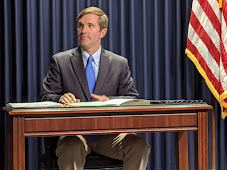
Gov. Andy Beshear
Beshear disagreed, reflecting on how scary it was early in the pandemic when the mortality rate from the virus was 10 percent in some places and essential workers were asked to show up at work every day.

"I believe this legislature needs to spend some of the last two days including hero bonuses. They deserve those hero bonuses. . . . I think it's really disappointing."

Health bills become law: Beshear signed three more health-related bills into law Thursday.

House Bill 525, sponsored by Moser, would allow Medicaid to pay certified community health workers. CHWs aren't trained medically, but are trained as patient advocates who come from the communities they serve. They help clients coordinate care, provide access to medical, social and environmental services, work to improve health literacy, and deliver education on prevention and disease self-management.

Senate Bill 10, sponsored by Sen. Robby Mills, R-Henderson, addresses the nursing shortage with both short-term and long-term solutions, including streamlining the process for out-of-state and foreign trained nurses to practice in Kentucky without compromising the standards of care; improving access to nursing education by removing "arbitrary" enrollment limits without compromising the quality of the programs; and adding term limits and geographic requirements for the Board of Nursing.

Senate Bill 105, sponsored by Sen. Max Wise, R-Campbellsville, will increase awareness and screenings for the cytomegalovirus (CMV), a virus that can cause childhood deafness and other health conditions. Most CMV infections are not diagnosed without newborn screening, resulting in missed opportunities for needed care. It is titled Bella Dawn Streeval’s Law, after a woman who died two years ago Thursday after suffering from CMV.

Wednesday, April 6, 2022

HPV Vaccine Conference on April 14 will be virtual; vaccine stops human papilloma virus, which causes certain types of cancer

The Kentucky Rural Health Association is devoting a one-day conference to discuss a vaccine that can protect against infections and cancers caused by the human papillomavirus.

The HPV Vaccine Conference, which was to be held in Bowling Green, will now be held virtually on April 14 between 9 a.m. and 3 p.m. ET. Click here to register. 

Among other topics, speakers who will talk about strategies to improve HPV immunization rates, rural HPV data, HPV vaccine resources and inter professional collaborations to increase HPV vaccination.

HPV is the most common sexually transmitted infection in the U.S. and can cause cancers of the cervix, vagina, vulva, penis, anus, rectum, throat and the back of the tongue. More than 90 percent could be prevented by the vaccine, according to the Centers for Disease Control and Prevention.

The vaccine is recommended for all 11- and 12-year-olds, but can be given up to the age of 45. In 2020, only 55.7% of Kentucky teens aged 13 through 17 had received all recommended doses of the HPV vaccine, slightly below the national rate of 58.6%, according to the America's Health Rankings. Kentucky ranks 29th among the states.