This is default featured slide 1 title

Go to Blogger edit html and find these sentences.Now replace these sentences with your own descriptions.This theme is Bloggerized by Lasantha Bandara - Premiumbloggertemplates.com.

This is default featured slide 2 title

Go to Blogger edit html and find these sentences.Now replace these sentences with your own descriptions.This theme is Bloggerized by Lasantha Bandara - Premiumbloggertemplates.com.

This is default featured slide 3 title

Go to Blogger edit html and find these sentences.Now replace these sentences with your own descriptions.This theme is Bloggerized by Lasantha Bandara - Premiumbloggertemplates.com.

This is default featured slide 4 title

Go to Blogger edit html and find these sentences.Now replace these sentences with your own descriptions.This theme is Bloggerized by Lasantha Bandara - Premiumbloggertemplates.com.

This is default featured slide 5 title

Go to Blogger edit html and find these sentences.Now replace these sentences with your own descriptions.This theme is Bloggerized by Lasantha Bandara - Premiumbloggertemplates.com.

Tuesday, June 14, 2022

Study could help Type 2 diabetics who have high blood pressure that doesn't keep the normal rhythm of falling at night

If you're a Type 2 diabetic and have a problem with high blood pressure at night, you might be able to control it by limiting your eating to to a specific window of time during each day. So suggests a study on mice at the University of Kentucky College of Medicine.

The study, published in the Proceedings of the National Academy of Sciences, was conducted by Ming Gong, a professor in the UK Department of Physiology, and Zhenheng Guo, a professor in the Department of Pharmacology and Nutritional Sciences.

“We are excited about these findings and the implications they could have in future clinical studies," Guo said in a UK news release. “In addition to lifestyle changes like diet and exercise, time-restricted eating could have a healthy impact on people with Type 2 diabetes.”

Blood pressure is normally low at night, but that doesn't happen in some people with hypertension and Type 2 diabetes, and is associated with heart and vascular disease.

The study found that imposing time-restricted feeding kept diabetic mice from developing the problem, and restored blood-pressure rhythm in mice that already had the problem.

"Researchers restricted the mice's access to food to eight hours during their typical active awake times every day," the UK release said. "When food availability was increased to 12 hours, the practice was still effective in preventing and treating nondipping blood pressure. Guo says this is evidence that the effects were caused by the timing of feeding and not calorie restriction."
Monday, June 13, 2022

Kentucky's Covid-19 cases and hospitalizations keep rising, somewhat steeply, but the positive-test rate is slightly lower

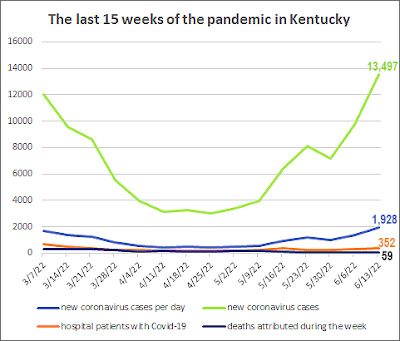
Kentucky Health News graph, from state data; click on it to enlarge.
By Melissa Patrick
Kentucky Health News

While coronavirus cases and Covid-19 hospitalizations in Kentucky went up last week, at much the same acceleration as the week before, the share of Kentuckians testing positive for the virus went down just a bit.

The state's weekly report shows the share of Kentuckians testing positive in the last Monday-to-Sunday reporting period, while still high, dropped .35 percentage points to 12.07%, from 12.42% the prior week. The figures do not include results from home tests. 

New cases have been on the rise for several weeks. This week's report showed 13,497 new cases of the virus, an average of 1,928 per day. That's 38% more than the week before, when the rate was 1,394 cases per day. Of this week's new cases, 14% of them are in people 18 and younger. 

The New York Times ranks Kentucky's infection rate 15th among the states and Washington, D.C., with a 42% increase in cases in the last two weeks. 

Despite the big increase in cases, the statewide incidence rate rose only a little, to 24.42 cases per 100,000 residents, from 23.97 the week before. The top 10 counties for this measure are: Carter, 48.5; Rowan, 45; Leslie, 40.5; McCracken, 39.5; Clark, 38.6; Boyd, 37; Lawrence, 36.4; Bourbon, 36.1; Wolfe, 35.9; and Monroe, 34.9.

The Lexington-Fayette County Health Department reported Monday that Lexington has had 100,649 total cases of the virus and 625 Covid-19 deaths. The current seven-day rolling average in Lexington is 147 cases a day, compared to 90 per day a month ago, says the health department.

The best protection against the virus is to get fully vaccinated and boosted, along with wearing a mask in indoor places, avoiding close contact with people who are sick, covering coughs and sneezes, avoiding touching your eyes, nose and mouth and regularly washing your hands with soap and water for at least 20 seconds, the health department reminded in a news release. 

The state reported 59 more Covid-19 deaths last week, an average of 8.4 per day, the same as the previous week. The state's pandemic death toll is now 16,063.

Kentucky's Covid-19 hospitalization numbers remain low, but have increased a bit.  Kentucky hospitals reported 352 patients with Covid-19 Monday, up from 299 a week ago, with 50 in intensive care (up 16) and 25 on mechanical ventilation (up eight). 

Statewide, 75% of intensive-care beds are in use, with four of the state's hospital regions using at least 80%. Northern Kentucky continues to have the highest rate of intensive care bed use, at 98.68%, but only 4.8% of those patients have Covid-19. 

The latest Centers for Disease Control and Prevention national Covid-19 risk map, which measures cases and hospital capacity, shows 19 Kentucky counties with a high level of coronavirus transmission and 28 with a medium level of risk. The map is updated on Thursday evenings.

Drug overdose deaths in Kentucky rose nearly 15% last year; fentanyl involved in 73% of deaths, methamphetamine in 48%

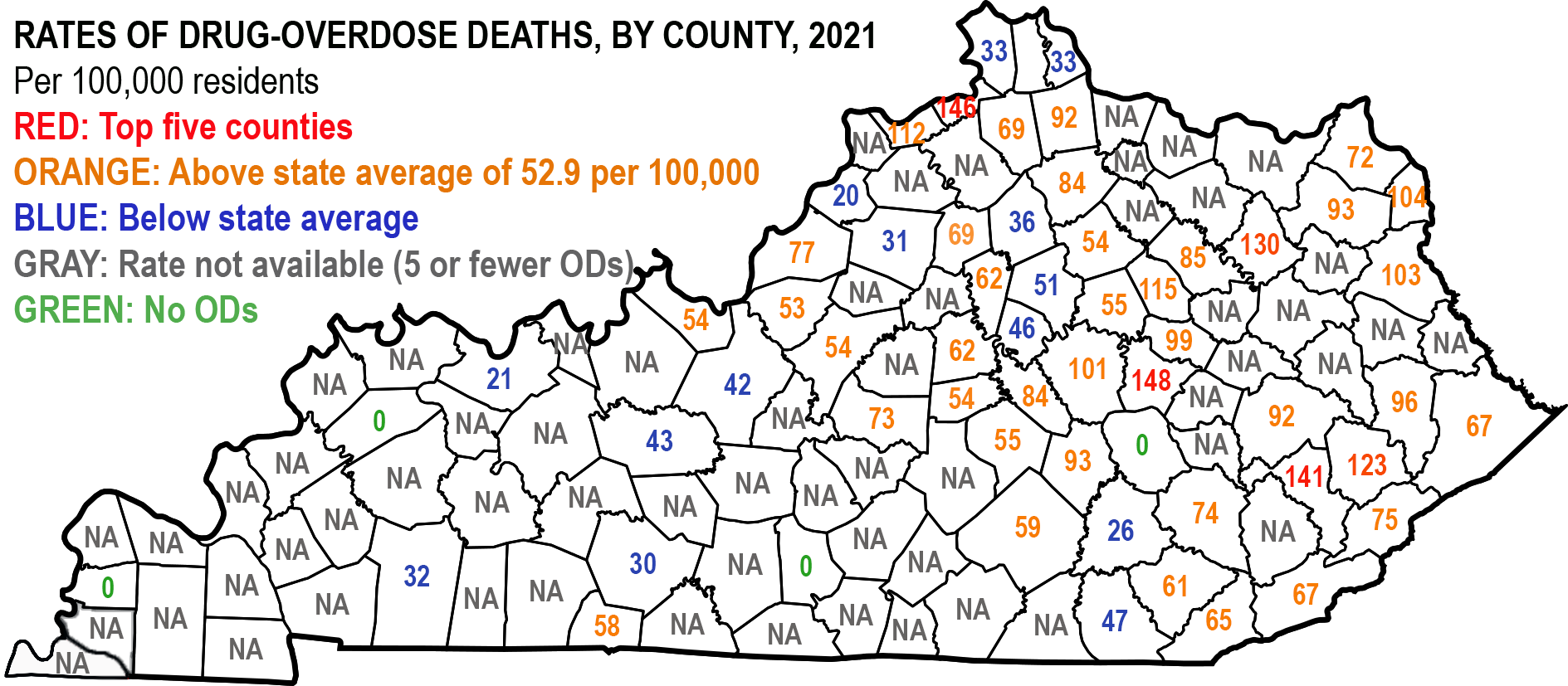
Kentucky Health News map from state data; click on it to enlarge (see note on table below)
By Melissa Patrick
Kentucky Health News

Drug-overdose deaths in Kentucky rose 14.6 percent in Kentucky in 2021, according to the state's annual report released Monday.

“The drug epidemic is not a Kentucky issue or political issue, but a nationwide issue that is affecting everyone and every state,” Van Ingram, executive director of the state Office of Drug Control Policy, said in a news release. “Our focus over this next year will be on increasing access to clinical care for those suffering from an addiction and offering more harm reduction measures.”

The state recorded 2,250 overdose deaths in 2021. That was 286 more OD deaths than the 1,964 reported in 2020, when the increase from the previous year was 54%. 

Estill County had the highest rate of fatal overdoses in 2021, 148 per 100,000 residents (adjusted for age of the population). It was followed by Gallatin, 146; Perry, 142; Rowan, 131; and Knott, 123. The report cautions that counties with fewer than 20 OD deaths per year, as was the case in all but Estill, Perry and Rowan, are unstable and should be interpreted with caution.

Kentucky Health News table, from state data; yellow counties
had fewer than 20 overdose deaths, so their rates are less reliable; 
rates were not released for those with fewer than 10 OD deaths.
The report does not give rates for counties with fewer than 10 overdose deaths, nor the actual number of in counties with 5 or fewer OD deaths. The number of counties with 10 or more OD deaths rose to 57 in 2021 from 44 in 2020. 

Jefferson County, the state's most populous, again had the most resident overdose deaths of any county, 569. That was an increase of 11% from the 512 recorded in 2020. The county's OD-death rate was 77 per 100,000, well above the statewide rate of 52.9 per 100,000.

Toxicology reports show that fentanyl was involved in 1,639 of the overdose deaths, or about 73% of them. That was an increase of 16% from the 1,413 overdose deaths involving fentanyl in 2020.

Methamphetamine was found in 1,075 of the overdose victims, or about 48%. This is an increase of 33% from the 809 OD deaths involving methamphetamine in 2020. 

Heroin was involved in 93 of the 2021 overdose deaths, a decrease from 191 in 2020. Also seeing decreases from the prior year were morphine, detected in 309 cases; acetyl fentanyl (256);  and alprazolam (211), among others. 

Oxycodone saw a slight decrease from the prior year, having been identified in 198 drug overdose deaths in 2021, down from 201 cases in 2020. 

Some of the drugs that saw increases from the prior year's toxicology reports were amphetamines, in 945 cases; gabapentin (503); THC (476); cocaine (300); hydrocodone (199); tramadol (129) and diazepam (85). 

The age group in which Kentucky overdose deaths are most common continues to be 35 to 44. Next is 45-54, which ranked third in the 2020 report and traded places with the 25-34 range in this year's report. Ranking fourth were the 55-64-year-olds. 

Over the years, Kentucky has supported  programs, legislation and research to battle substance-use disorder, along with funding support. 

“Here in the commonwealth, we have been fighting a long battle against the opioid epidemic. This public-health crisis has torn families apart and taken the lives of far too many Kentuckians, far too soon,” Gov. Andy Beshear said in the release. “Every day we must work together to fund recovery programs and treatment options so that we can continue to address this scourge and get our people the help they need.”

Data for the report was compiled with data from the Kentucky Office of the Medical Examiner, the Kentucky Injury Prevention & Research Center, and the Kentucky Office of Vital Statistics.

People who are struggling with drug abuse or who are concerned about a family member's substance use can search for treatment providers at www.findhelpnowky.org. The KY Help Call Center (1-833-859-4357) also provides information on treatment options an open slots among treatment providers. The Kentucky State Police has also launched the Angel Initiative, which allows anyone with a substance-use disorder seeking treatment to visit a KSP post where they are directed to treatment.

State Labor Cabinet reminds employers to protect employees as heat indexes hit triple digits and a hot workweek is forecast

CDC photo
As heat indexes went well into the triple digits Monday and weather forecasts predicted a hot workweek, the state Labor Cabinet reminded employers to protect employees working in hot conditions.

Labor Secretary Jamie Link urged employers to "establish a heat illness prevention plan, closely monitor workers in hot indoor and outdoor environments, and learn how to recognize and treat various heat-related illnesses," a cabinet press release said.

“Employers are responsible for providing safe workplaces free of known hazards, and that includes extreme heat conditions,” Link said in the release. “Asking workers to perform physically exhausting work in dangerously hot conditions without providing breaks, water and shade can result in serious illness and even death.”

The federal Occupational Safety and Health Administration recommends regular water, rest and shade breaks for those working in hot environments, outdoors or indoors. OSHA and the National Institute for Occupational Safety and Health have free mobile application for Android and iPhone users that provides real-time heat index information and hourly forecasts by location, as well as occupational safety guidance and health recommendations. The tool can be found on Google Play and in Apple’s App Store.

Kentucky's program provides free, confidential heat exposure assessments by request, and offers a Heat Stress Awareness training module on its website. The cabinet is offering a class on heat stress during a population center training event June 21-24 in Frankfort.

Sunday, June 12, 2022

Sons of smokers may be more probe to addiction-like behaviors, memory problems and anxiety, Univ. of Pennsylvania study says

If you're a parent who smokes, your sons may be more susceptible to addiction-related symptoms, memory problems and anxiety, says a new study from researchers at the University of Pennsylvania. The study is another caution about tobacco for Kentuckians, about 25 percent of whom smoke, the second highest rate in the nation.

The researchers found an association between parental tobacco use and rates of "addiction-like behaviors, cognitive impairments, and anxiety-like behaviors" in sons, a Penn news release says. The researchers did not find a similar association in daughters. The study is published in the journal Molecular Psychiatry.

Heath D. Schmidt, the paper's lead author, explains that understanding the biological effects of tobacco use is necessary understand how to children can inherent their parents' drug use. He notes that these studies' findings "highlight vulnerable populations at risk for developing nicotine dependence, cognitive impairments, and/or mental health disorders.”

Kentucky's intensive-care units will give new parents insurer-funded kits so new parents can learn how to give CPR to infants

The Kentuckiana American Heart Association and the Kentucky Association of Health Plans, the association for companies selling and managing health insurance in the state, and have introduced a new initiative to equip thousands of new Kentucky parents with infant cardiopulmonary resuscitation kits. 

Training kit for giving infants cardiopulmonary resuscitation
The initiative is funded by a $95,000 grant from KAHP. The AHA will distribute 3,000 Infant CPR Anytime Training® Kits to newborn intensive-care units throughout the state. The kits include an inflatable manikin along with a video course designed to provide infant choking and CPR training in about 20 minutes. 

 “We’re excited to provide funding for this partnership with the American Heart Association. This is an extremely effective tool that will increase the chances of survival in the face of an emergency and equip new parents with the confidence to administer lifesaving techniques," Katherine Kington North, director of external affairs for KAHP, said in a news release.
 
The release notes that the at-home kits will fill voids created by staffing problems related to the Covid-19 pandemic. They will be available in English and Spanish. The AHA began deliveries of the kits in mid-May, with 1,900 distributed to date, says the release. The KAHP gift capped off National CPR Awareness Week, which ran from June 1-7 this year.

“With preterm infants, there are twice as many cardiovascular malformations as those born at full term, so the kits are especially important to those families,” Dr. Sandra Guerra, chief medical director for KAHP member WellCare of Kentucky and board chair of the Kentuckiana AHA, said in the release. 

She added, “Premature infants may also have breathing difficulties due to an underdeveloped respiratory system, and should it be necessary, parents will have the know-how to administer aid before an ambulance arrives. The physical practice that these kits provide is tremendous.”

In 2020, there were 5,705 preterm births in Kentucky, representing 11% of live births, according to the March of Dimes.

UK HealthCare spending $5 million on security upgrades, setting new policies amid gun violence at health facilities in other states

Screenshot from UK website, adapted by Ky. Health News
The University of Kentucky is bolstering security at health-care campuses "in response to increasing reports of violence taking place across the nation in health-care settings," a news release said Friday.

UK said its police began using handheld metal detectors on all patients and visitors entering emergency departments in April 2021, followed by installation of fixed metal detectors in July 2021. Other recent measures include having at least one police officer at each of the emergency departments around the clock.

The release said UK will spend $5 million on health-care safety, including:
  • Addition of electronic access control to all perimeter doors to restrict public access as well as replacement and modernization of aged entryways.
  • Utilization of emerging technology to enhance threat detection and expanding panic alarms and lockdown capabilities.
  • Increased security camera coverage to improve situational awareness.
  • Addition of UK Blue emergency towers to walkways where staff and patients travel frequently.
  • Enhancement of exterior lighting to improve visibility around UK HealthCare facilities.
At a virtual forum for UK HealthCare employees, Executive Vice President for Health Affairs Mark Newman and UK Police Chief Joe Monroe discussed their efforts to improve the safety and security of employees, patients and visitors.

“We also are researching better ways to make UK HealthCare a weapons-free location through screening technology and looking at strategic efforts to increase dedicated police presence on the UK HealthCare campus,” Monroe said.

The moves were announced in the wake of the June 1 killings of four people at a Tulsa hospital by man who blamed his doctor for pain after back surgery and also killed himself, but the news release said UK Police have worked for a year with a security consultant on the first phase of a continuing security review "with an initial focus on enhancing perimeter security and fortifying the emergency departments at UK Chandler Hospital and UK Good Samaritan Hospital," the news release said.