This is default featured slide 1 title

Go to Blogger edit html and find these sentences.Now replace these sentences with your own descriptions.This theme is Bloggerized by Lasantha Bandara - Premiumbloggertemplates.com.

This is default featured slide 2 title

Go to Blogger edit html and find these sentences.Now replace these sentences with your own descriptions.This theme is Bloggerized by Lasantha Bandara - Premiumbloggertemplates.com.

This is default featured slide 3 title

Go to Blogger edit html and find these sentences.Now replace these sentences with your own descriptions.This theme is Bloggerized by Lasantha Bandara - Premiumbloggertemplates.com.

This is default featured slide 4 title

Go to Blogger edit html and find these sentences.Now replace these sentences with your own descriptions.This theme is Bloggerized by Lasantha Bandara - Premiumbloggertemplates.com.

This is default featured slide 5 title

Go to Blogger edit html and find these sentences.Now replace these sentences with your own descriptions.This theme is Bloggerized by Lasantha Bandara - Premiumbloggertemplates.com.

Monday, March 20, 2023

Get prepared now for Medicaid renewals, Kentucky

By Kennan Wethington
President, Anthem Blue Cross and Blue Shield in Kentucky

When Covid-19 hit three years ago, the federal government responded with a series of actions made possible by declaring a Public Health Emergency, also called the PHE. One of these actions was to freeze a process called Medicaid renewal, allowing Medicaid members to remain in their plans regardless of status or eligibility changes. That will all change in the coming weeks.

260,000 Kentuckians Could Lose Coverage: Recent federal legislation ended continuous enrollment in Medicaid, allowing renewals to begin on April 1. As a result, the extended health coverage for some on Medicaid will end, with disenrollments expected as soon as June 1. Here in the commonwealth, up to 260,000 people and as many as 18 million across the country could be affected.

The good news for those losing Medicaid coverage is that new subsidies may make Marketplace health plans more affordable than ever. In addition, many helpful resources are available to guide people to the coverage and support they need. With Medicaid renewal resuming, now is the time to begin preparing.

Start planning now: Here’s a checklist for all Medicaid beneficiaries to get ready for Medicaid renewal:

1) Make sure Kentucky’s Department for Medicaid Services has your current contact information by visiting kynect.ky.gov or call kynect at 855-4KYNECT (855-459-6328)

2) Watch closely for letters and information from Kentucky Medicaid and respond to them quickly.

3) Visit the Kentucky Health Benefit Exchange at khbe.ky.gov/Enrollment/Pages/PHEUnwinding.aspx for help understanding Medicaid eligibility changes.

4) Even if you still qualify for coverage, you may receive renewal instructions from Kentucky Medicaid. Make sure to follow instructions carefully.

5) If you don’t qualify, start making plans now to find affordable health plans through your employer or the Marketplace. Don’t let your coverage lapse.

A change of employment will be a common reason many Kentuckians will no longer qualify for Medicaid plans. The next step for people in this situation is to talk to their employer to determine if they are eligible for employer-sponsored health benefits. If employer-based health plans are not an option, an Affordable Care Act health plan through the Kentucky Health Benefit Exchange, is likely the best choice for health coverage.

There are options if you lose Medicaid: If you no longer qualify for Medicaid coverage and employer-sponsored plans are not an option, understanding health coverage choices available through the Health Insurance Marketplace and how to enroll can take some time to sort out. That’s where we come in – those of us in the community dedicated to connecting people to quality, affordable health care. Two helpful sources are:
  • The Kentucky Health Benefit Exchange, at khbe.ky.gov, is full of information, resources, agents, and health coverage guides called kynectors who can answer questions and help you understand your coverage options.
  • HealthCare.gov is another warehouse of information, quick start guides as well as connections to healthcare navigators and brokers in each community.
All these information tools, agencies, and surprisingly affordable health plan options work together, making sure no one falls through the gaps.

Health care can still be affordable and equitable: The Affordable Care Act led to the creation of health plans that go beyond basic coverage, yet remain affordable even for those who don’t qualify for Medicaid and lack access to employer-sponsored coverage. Marketplace plans cover essential health benefits, including emergency services, prescription drugs and pediatric services, and they offer no cost preventive care. This means consumers pay nothing for important services such as regular wellness visits, immunizations and screenings. These services are key to avoiding and managing serious health conditions.

Marketplace plans are often more affordable than ever because federal subsidies have been expanded through 2025 to help keep costs down for consumers. Most people covered by these plans receive a federal subsidy, and in fact, some families that qualify for subsidies will pay nothing for coverage. If you did not previously qualify for subsidies, you may now be eligible.

Let’s stick together, Kentucky: More than ever, the last three years taught us that health is a group effort, and that equitable, affordable access to healthcare is vital to our physical, mental, and financial well-being. We learned that our health is interconnected not just to each other as Kentuckians, but also to our commonwealth’s entire economy. We’re at a pivotal moment, let’s not lose the momentum we’ve gained. If you’re impacted by Medicaid renewals, please start preparing now to keep you and your family protected with health coverage that works for you.

Friday, March 17, 2023

Ernie Scott of Letcher County dies of rare brain aneurysm at 46; had been director of the State Office of Rural Health since 2013

Ernie Lee Scott
Funeral services were held Friday for Ernie Scott, who was director of the State Office of Rural Health in the University of Kentucky Center of Excellence in Rural Health. He died of a rare brain aneurysm Sunday, March 12, at his home in Partridge, in Letcher County. He was 46.

Scott started his career as a radiology technologist, earned a bachelor’s degree in health care administration at Midway College, and became director of the Office of Rural Health in 2013.

In 2014 received the Emerging Leader Award from the National Organization of State Offices of Rural Health, and in 2020 won th Kentucky Rural Health Association's Dan Martin Award for lifetime contributions to rural health. Last year, the office was one of three organizations in the nation to receive a three-year, nearly $900,000 grant from the federal Office of Rural Health Policy to improve access to health care for veterans living in rural Kentucky and to improve coordination of veterans' care.

Scott is survived by his wife, Tiffany Bullock Scott, and their daughter, Addyson Grace Scott. The couple owned and operated the General Store at Pine Mountain Crossing on US 119. Other survivors include his mother, Iris Jean Scott; siblings Howard Wayne Scott (Renee) and Sherry Scott Geiger (David); and many nieces and nephews.

"To know Ernie was to love him," his obituary says. "He quickly became a friend to all he met. He always greeted folks with a smile and often a big hug. He was a planner, a goal setter, and achiever. He loved his family, friends, church, and his community. He poured his heart and soul into Letcher County (specifically Cumberland River) and made huge impacts in many other rural communities."

His funeral was at Lewis Creek Pentecostal Church, along the Poor Fork of the Cumberland River in Partridge, with burial in the D.L. Creech Cemetery four and a half miles downstream, at Cumberland. Tri-City Funeral Home was in charge.

Memorial donations may be made to a health-care scholarship fund in Scott’s name at Commercial Bank, 1701 E. Main St., Cumberland KY 40823.

Medical cannabis bill passes Senate, awaits House vote March 30

By Melissa Patrick
Kentucky Health News

A bill that would make medical marijuana legal for some in Kentucky has passed the state Senate for the first time and awaits a vote in the House, which has passed two similar bills in previous legislative sessions.

Sen. Stephen West
"It is time for Kentucky to join the other 37 states in the United States that allow medical marijuana as an option for their citizens," said Sen. Stephen West, R-Paris, in presenting his bill to the Senate, adding later, "It is understood that this is a very complex issue and if passed, will be a work in progress." 

Senate Bill 47 passed late Thursday night on a 26-11 vote. The House gave the bill its first of three required readings the same night, which will allow enough time for it to pass out of the House when the lawmakers return March 29 and 30.

Last year, after a House-passed bill again got no hearing in the Senate, Gov. Andy Beshear used his pardon power to allow people with 21 specified medical conditions and a doctor's certificate to possess up to eight ounces of marijuana bought legally in another state. (Illinois is the only adjoining state where nonresidents can legally buy cannabis.) Beshear signaled Thursday that he would sign the bill.

West, who said he has worked on such legislation for about five years, told the Senate, “This is one of those issues where you take out the ledger and you list the pros and cons. It’s a long list on both sides, but for me personally, the pros outweigh the cons.”

The 124-page bill would not allow medical marijuana to be smoked, require users to be 18 or older or be a caretaker for a child, limit supply, and not take effect until Jan. 1, 2025.

The medical marijuana would be allowed for certain "qualifying medical conditions," including all cancers regardless of the stage; chronic, severe, intractable or debilitating pain; epilepsy or any other tractable seizure disorder; multiple sclerosis, muscle spasms or spasticity; chronic nausea or cyclical vomiting syndrome that has proven resistant to other conventional medical treatments; post-traumatic stress disorder; and any other medical condition or disease for which the new Kentucky Center for Cannabis Research at the University of Kentucky determines would benefit from medicinal marijuana.

West and other lawmakers praised the advocacy of Eric and Michelle Crawford, a quadriplegic who has long searched for another option to manage his pain. They also praised the ongoing work of advocate Jamie Montalvo, who suffers from multiple sclerosis, toward getting this bill passed. 

 Sen. Phillip Wheeler, R-Pikeville, said the Crawfords and Montalvo don't want to break the law: "These are people that are willing to work hard and make sacrifices to comply with the law. What they are looking for is a pathway forward to make sure that people can get a safe product." 

Sen. Stephen Meredith, R-Leitchfield, said it was important to show those who are suffering from  debilitating diseases  "just a little bit of mercy" and that was why he voted yes.   

“Will this be abused by some folks?  It certainly will," he said. "But again, if we can benefit just one person, one child, I think it’s worthwhile."

Only Republicans voted against the bill: Gary Boswell of Owensboro, Danny Carroll of Benton, Donald Douglas of Nicholasville, Rick Girdler of Somerset, President Pro Tem David Givens of Greensburg, Chris McDaniel of Ryland Heights, Robby Mills of Henderson, John Schickel of Union, President Robert Stivers of Manchester, Mike Wilson of Bowling Green, and Max Wise of Campbellsville. 

Marijuana is a "scourge of the earth," Boswell said. "I urge my colleagues to vote no. If you are going to violate federal law, at least tighten up the bill to include only the critically ill." 

Douglas, a physician, said, “With the different growing techniques and the increased concentration of these chemical compounds, I’m not really convinced that this drug is safe. But we do have some research going on out there, and I really want to thank the University of Kentucky. I hope we have some other institutions doing research who will give us good information.”

Bill to ban gender-affirming care for youth goes to Beshear after advocates do an end-run to quash bipartisan Senate changes

By Melissa Patrick
Kentucky Health News

A revised bill with language to ban gender-affirming care for Kentucky's transgender youth moved quickly through both houses of the General Assembly Thursday and is on Gov. Andy Beshear's desk.

Even if the Democratic governor vetoes the bill, as is expected, the supermajority of Republicans in the legislature can override the veto when they return on March 28 and 29. 

Changes made to Senate Bill 150, sponsored by Sen. Max Wise, R-Campbellsville, were approved in a hastily called meeting of the House Education Committee, which approved it 16-5 with Republican Rep. Killian Timoney of Nicholasville voting "no" with the four Democrats on the committee.

Soon after, the amended bill passed the House 75-22, despite more than two hours of Democrats speaking against it.

SB 150 moved quickly to the Senate for concurrence with the House changes. It passed 30-7 to shouts and obscenities yelled from the gallery at legislators. Sen. Danny Carroll of Benton was the only Republican to vote against the bill and Sen. Robin Webb of Grayson, was the only Democrat for it.

The night before, Carroll had narrowly succeeded in watering down a House bill that would limit gender-affirming care, but after his floor amendment passed 19-17 the Senate laid HB 470 on the clerk's desk and Wise worked with the House to put most of the original bill into SB 150.

The amended version of SB 150 prohibits gender-affirming medical care for trans youth, including gender-affirming surgery or puberty-blocking hormones. It allows health-care providers to de-transition youth who are already taking such hormones, which would require them to taper them off of the drugs. It also provides exemptions for youth who have a diagnosed sexual-development disorder. 

Providers who violate the law would have their licenses revoked, and youth who claim injury as a result of gender-affirming care could fule suit to recover damages until they turn 30 years old or within three years from the time they discovery the injury. The normal deadline for a lawsuit is one year.

SB 150 also includes its original provisions to prohibit schools from requiring teachers to use a trans student's preferred pronouns and requires schools to notify parents about any content related to sexuality. It also added content from HB 177, which does not allow any sex education to children in grades five and below and bans all students from receiving instruction that explores "gender identity, gender expression or sexual orientation."

Sen. Danny Carroll speaks on SB 150. (Legislative photo) 
Carroll's revised bill likewise prohibited surgical medical treatments for trans youth, but unlike allowed some nonsurgical medical-treatment options. 

His change was supported by all seven Democratic senators and 12 of the 31 Republicans. Seven of them voted the other way when Wise's bill came back from the House. It passed 30-7.

Carroll, explaining his no vote, said, "We know that most kids that are struggling with gender dysphoria decide to stay the gender that they are. It's a phase that they go through, [and for] some it's not. What would it hurt to allow doctors to have access to these puberty blockers to give these kids time to work through the issues that they face? Why can't we trust our doctors, as we do for every other issue, to guide us through these things?"

Sen. Karen Berg, D-Louisville, whose trans son Henry died by suicide in December, said of SB 150, "This is absolutely willful hate for a small group of people that are the weakest and most vulnerable among us."

Sen. Whitney Westerfield, R-Fruit Hill (Christian County), said his yes vote was "reluctant." He said SB 150 was better than HB 470 largely because it allows doctors to talk freely with their patients about their medical concerns without fear of liability.  

During the House floor debate, Rep. Chad Aull, D-Lexington, reminded the lawmakers that nearly half of LGBTQ individuals have seriously considered suicide and that percentage is much higher with transgender children. "If this legislation causes one child in Kentucky to consider or to take their own live, this is a wrong piece of legislation," he said.

Terry Brooks, executive director of Kentucky Youth Advocates, issued a statement calling the speedy passage of SB 150 "parliamentary shenanigans" and that the genesis of the measure "springs from a national agenda of fearmongering."   

"Passage of SB 150, even with the amendment, means that kids lose access to much needed health and mental health supports. It means that families lose vital rights. And it means that Frankfort Republicans – save the courageous Representatives Banta, Dietz, Moser, and Timoney and Senator Carroll, who refused to vote in support of the measure – lose their long-held core governing identity. That is a lose-lose-lose trifecta for us all," he said. 

Senate Majority Floor Leader Sen. Damon Thayer, R-Georgetown, who voted for the bill, said SB 150's anti-trans provisions were modeled after a law in South Dakota. 

Rep. Kim Moser, R-Taylor Mill, while explaining her "pass" vote said, "I'm concerned that it doesn't comment enough on the mental-health treatment. . . . I really would like to see that we are allowing for mental-health treatment, watchful waiting and making sure that we're supporting the families who are going through this issue. I'm passing today because we want to protect children on all sides of this issue." Moser is chair of the House Health Services Committee.

Tamarra Wieder, state director for Planned Parenthood Alliance Advocates, voiced her disappointment: "SB 150 is deliberately designed to create a culture war across this commonwealth. It has nothing to do with parental rights. It has nothing to do with caring for kids. What it does is go against the guidance of every major medical association in this state. It replaces our physicians with politicians and places our trans kids' lives on the line." 

Thursday, March 16, 2023

Medical marijuana passes Senate committee, awaits floor vote

L-R: Eric Crawford, Jamie Montalvo, Sen. Stephen West and Chris Joffrion spoke in favor of West's medical marijuana bill in the Senate Licensing and Occupations Committee. (Legislative photo)  
By Melissa Patrick
Kentucky Health News

For the first time, a bill to legalize and regulate medical marijuana in Kentucky has cleared a Senate committee after years of the idea being stalled in the upper chamber. 

Senate Bill 47, with a committee substitute, passed out of the Senate Licensing & Occupations Committee March 14 on an 8-3 vote. Republican Sens. Donald Douglas of Nicholasville, Committee Chair John Schickel of Union, and Chris McDaniel of Ryland Heights, cast the "no" votes. 

Senate Majority Floor Leader Damon Thayer of Georgetown, a long-time opponent of medical marijuana legislation, was among those voting in favor of the bill, saying he approved its narrow focus and that his support was for "the sake of those who suffer." 

The 124-page bill, sponsored by Sen. Stephen West, R-Paris, does not allow medical marijuana to be smoked, requires users to be 18 or older or be a caretaker for a child, and would not take effect until Jan. 1, 2025.

The medical marijuana would be allowed for certain "qualifying medical conditions," including all cancers regardless of stage; chronic, severe, intractable or debilitating pain; epilepsy or any other tractable seizure disorder; multiple sclerosis, muscle spasms or spasticity; chronic nausea or cyclical vomiting syndrome that has proven resistant to other conventional medical treatments; post-traumatic stress disorder; and any other medical condition or disease for which the new Kentucky Center for Cannabis Reserach determines would benefit from medicinal marijuana. 

Longtime advocate for medical marijuana Eric Crawford of Mason County, who has been a quadriplegic for nearly 30 years, said marijuana improves the quality of his life and that he and others who benefit from it "deserve legal access without the worry of law enforcement."  

“It allows me longevity and a better quality of life. It allows me to be a better husband, son, friend and man than a pharmaceutical route. Surely there’s nobody on this committee that thinks I’d be better off taking opioids,” he said.

Sandra Marlowe, the sister of Sen. Gex Williams, R-Verona, who is wheelchair-bound due to the debiliating and deadly disease ALS, also asked the committee members to pass the bill. 

“This disease will take my life. I ask that my days be as comfortable as possible with access to the THC tincture. That is the only thing that gives me relief. . . . Without painful cramps, I am more productive," she said. 

Thayer told the Lexington Herald-Leader on Tuesday that the bill had time to get its two required readings for a vote on the Senate floor Thursday, the final legislative day before the veto session. However, he added that he's not sure it has the Senate floor votes to get passed.

If the Senate passes the bill Thursday and gets a reading in the House, the House coulld pass it when the lawmakers return for the last two days of the session, usually reserved fro veto overrides. Medical marijuana bills have passed out of the House twice.

Two people spoke against the bill: Michael Johnson of the Family Foundation and Gene Cole of the Kentucky Ethics League/ Kentucky League on Alcohol, Gambling Problems and Substance Use Disorder

Johnson said the while he is sympathetic to people who have not found relief from their ailment from modern medicine,  there is "insufficient scientific evidence that marijuana is an effective pain relieving agent or that it is safe and effective as a medicine." He also called for "more research"  before it is legalized.

Tuesday, March 14, 2023

Long Covid update: There's still reason to avoid Covid-19, even if you've had it already; it's 'annoyingly stubborn,' expert says

By Katelyn Jetelina
Covid-19 is not the common cold. Here’s an effort to keep you up to date on long-Covid developments.

What we knew: Long Covid after first infection was clearly a risk. The risk of long Covid after re-infection was not known.
New info: In the U.K., risk of long Covid dropped after second infections compared to first infection (4% → 2.4%). This is good and bad news: Risk drops, but risk is clearly not zero.
Why it matters: There is still reason to avoid Covid-19, even if you’ve had it already.

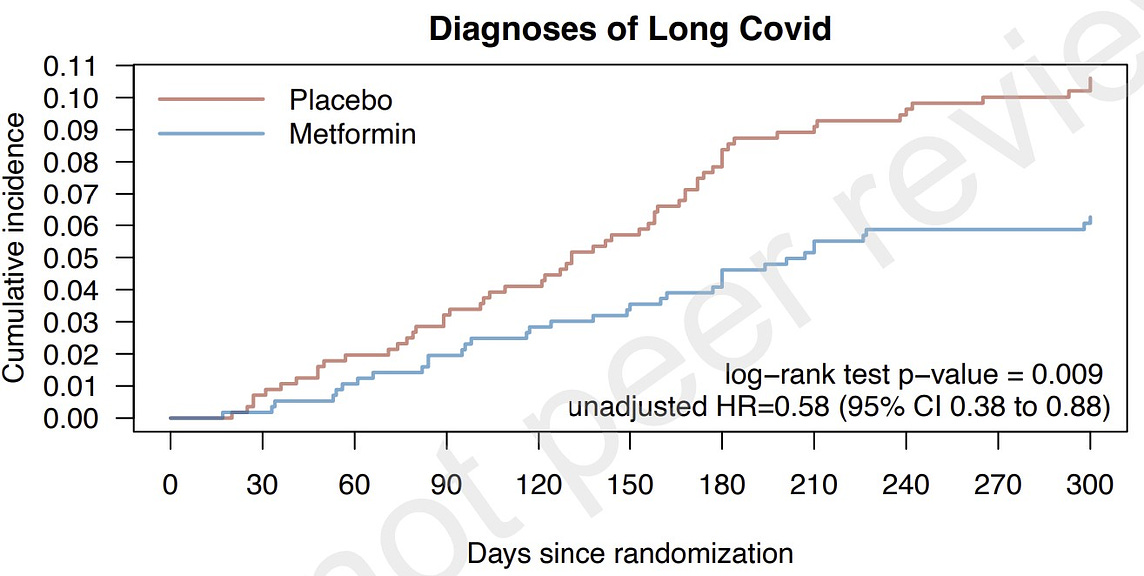
Metformin may work

What we knew: About 300 clinical trials are testing treatments for long Covid-19, including Metformin. Results are trickling in.
Cumulative incidence curve of long-Covid diagnoses over
10 months after randomization. Source: 
Lancet preprint.
New info: Metformin reduced long Covid in a large randomized control trial.
Metformin had a 42% reduced risk in long Covid cases compared to the placebo; 63% reduced risk if taken within four days of symptoms.
For every 100 people who took the drug, four fewer cases of long Covid nine months after infection occurred. Ivermectin and fluvoxamine had no impact.
Why it matters: People should consider Metformin, especially women who are at higher risk for long Covid. It’s best taken within four days of infection. This is a challenging timeframe in the U.S. medical care system, though.

Paxlovid may help… a little?
 
What we knew: Paxlovid helps reduce severe disease by 50-90%. We didn’t know if it helped with long Covid, though.
New info: Paxlovid reduced risk of long Covid by 26%, regardless of vaccination status and history of prior infection. We need more studies, particularly among young people, as Paxlovid’s effect will likely increase among younger people.
Why it matters: There may be small, proxy benefits from taking Paxlovid, including among younger populations that aren’t “eligible.”
 
Long Covid is annoyingly stubborn

What we didn’t know: We didn’t know the longevity of severe symptoms.
New info: Among those with long Covid, the rate in which symptoms affected daily life decreased from 45% → 25% over seven months.
Why it matters: If you get severe long Covid, there is a chance that symptoms will get better after seven months. Then again, there’s a chance that they won’t.

Still not convinced?

What we know: People living with long Covid report profound stigmatization because people disbelieve that long Covid is a “thing.”

New info: A community member of this newsletter, Dianna Cowarn (also known as Physics Babe on YouTube), was diagnosed with long Covid last summer. Her crew made a 4-minute video. Check it out here if you’re still not convinced. It’s painstaking [and is preceded by ads].


Bottom line: Covid-19 infection is not the common cold for some. Our knowledge is inching closer to treatments. But with so much unknown, we still need to emphasize prevention—keeping Covid-19 cases low and ensuring vaccination.

Katelyn Jetelina (MPH, PhD) is an epidemiologist, data scientist, wife, and mom of two little girls. She works at a nonpartisan health policy think tank and is a senior scientific consultant to the CDC and other organizations.

Friday, March 10, 2023

Bill to let advance-practice registered nurses prescribe controlled substances on their own after four years passes, at long last

Image from Kentucky Association of Nurse Practitioners and Nurse Midwives Facebook page

By Melissa Patrick
Kentucky Health News

A bill to create a path for Kentucky's advanced-practice registered nurses to prescribe controlled substances independently has finally passed and is on its way to the governor's desk. 

After seven years of debates and months of negotiations with the powerful Kentucky Medical Association, Sen. Julie Raque Adams, a Republican from Louisville, was able to broker a compromise between the association and the Kentucky Association of Nurse Practitioners and Nurse Midwives. 

To cheers, the House passed Senate Bill 94 by a vote of 92-1, with the only dissenting vote coming from Rep. Kim King, R-Harrodsburg. 

Beth Partin, president of the APRN association, called the passage of this bill "momentous." 

"This means that APRNs will be able to improve access to care. We'll be able to help more people," she said, later adding, "I think it means that more nurse practitioners and nurse midwives will open practices in rural areas."  

Further, she said it means that APRNs won't have to pay "lots of money" to a collaborating physician "to sign the paper" that allows them to have a Drug Enforcement Agency number, which is needed if they want to open a practice. 

"You have to have a DEA number to order certain supplies like flu vaccine and oxygen and things like that. . . . So even if you didn't prescribe scheduled drugs, you still had to have that in order to establish your practice to get get the supplies you need," she said.

Jill York, executive director of the APRN association, said the passage of SB 94 could help about 3,000 veteran APRNs, who are working under a cooperatitve agreement that allows them to prescribe conrrolled substances and could begin the process of not working under a collaborative agreement. 

"They will be able to move toward independence from that agreement if they would like to," she said. "And it opens a lot of opportunity and a lot of doors for APRNs who might want to open their own practice somewhere in Kentucky." 

Partin, who has been involved with legislative work for 30 years and served on the negotiation team for the bill, praised the negotiation efforts between her association and the KMA, calling them respectful, professional and thoughtful. Further, she said there was a spirit of compromise and that everyone left their egos at the door. 

"I'm hopeful that that will carry over into the future because we share a lot of common interests," she said. 

Kentucky APRNs have been able to prescribe controlled substances since 2006 under agreements with with a physician. They are allowed to prescribe a 72-hour supply of a Schedule II drug, the highest class of controlled substance that can be prescribed, and SB 94 would not change that.

With the passage of the bill, an APRN who wants to prescribe controlled substances independently must work under an agreement for four years, have regular meetings with their collaborating physician while working under the agreement, undergo a license review by the Kentucky Board of Nursing, maintain a U.S. Drug Enforcement Administration registration and a master account in the Kentucky All-Schedule Prescription Electronic Reporting system.

The bill would establish the Controlled Substances Prescribing Council in the Office of the Inspector General at the Cabinet for Health and Family Services, which will meet at least quarterly to discuss the safe and appropriate prescribing and dispensing of controlled substances.