This is default featured slide 1 title

Go to Blogger edit html and find these sentences.Now replace these sentences with your own descriptions.This theme is Bloggerized by Lasantha Bandara - Premiumbloggertemplates.com.

This is default featured slide 2 title

Go to Blogger edit html and find these sentences.Now replace these sentences with your own descriptions.This theme is Bloggerized by Lasantha Bandara - Premiumbloggertemplates.com.

This is default featured slide 3 title

Go to Blogger edit html and find these sentences.Now replace these sentences with your own descriptions.This theme is Bloggerized by Lasantha Bandara - Premiumbloggertemplates.com.

This is default featured slide 4 title

Go to Blogger edit html and find these sentences.Now replace these sentences with your own descriptions.This theme is Bloggerized by Lasantha Bandara - Premiumbloggertemplates.com.

This is default featured slide 5 title

Go to Blogger edit html and find these sentences.Now replace these sentences with your own descriptions.This theme is Bloggerized by Lasantha Bandara - Premiumbloggertemplates.com.

Friday, July 19, 2024

Mental-health care access can be a challenge in Eastern Kentucky; on top of that, the subject still carries stigma for some

Appalachian Region Healthcare Behavioral
Health Facility (Photo submitted to WEKU)
By Stan Ingold
WEKU

Experts are concerned about a growing mental-health crisis nationally. This story looks at the struggles faced by those dealing with access to mental-health care in Eastern Kentucky.

“We're Appalachian people, so we're seen as being strong and that's how we want to portray ourselves, and if you have any kind of mental illness it is seen as a weakness," Kasey Wright says.

Wright is the system director of behavioral health, education, and psychological support for Appalachian Regional Healthcare. She said mental health carries a stigma for many people in Eastern Kentucky, and she and her colleagues try to persuade their patients otherwise.

“We try to tell our patients . . . if you have diabetes you have to treat that, its a medical condition. It's the same if you have depression, you have to treat that, it's a medical condition.”

For some, it takes a major incident for them to make the decision to seek help.

“I had a suicide attempt when I was 21,” said Valeri Jones of Morehead. She reached her tipping point almost 20 years ago. She said dealing with substance abuse and anxiety was getting to be too much for her to handle.

“I just couldn't live like that. I couldn't live feeling depressed and I couldn't function. I couldn't work. I lost my job. I just couldn't function,” she said. “So, that is when I was like, 'It's time to do something. It's a true, real chemical imbalance.'”

But it hasn't been an easy road. Once she started getting help, it was hard to find consistency with her treatment, she said: “My appointments would get canceled, they would get rescheduled and every third or fourth appointment that I would finally make it in for, now, some of that was my fault, I would have work or scheduling conflicts or whatever, when I would make it in, I was constantly with a new therapist.”

And she said seeing a new therapist every other visit was a struggle in and of itself.

Jones said it is frustrating because she is constantly told she needs to pair her medications with therapy.

“I'm told by my doctors that 'You need to pursue counseling, you need to be in therapy while taking these medications, because this is the most effective way to deal with your issues.' But then I'm trying to keep up my end of the bargain; but then I keep getting canceled and told, 'Basically, it doesn't really matter.'”

She said sometimes it makes her lose heart. “And it makes me not want to go, and I'm limited with what providers I have access to.”

Jones works in the mental-health field herself. She knows it isn't easy for those trying to help.

“I get it; the pay is not great, the work is demanding, it's mentally exhausting, but as someone on the other end of that, who is trying to get those services for myself, and someone with anxiety, it's hard to, it's hard to just go in and talk to someone period.”

This isn't the only hurdle people face. Kasey Wright, with ARH, said that in southeastern Kentucky, sometimes even just getting to an appointment is difficult.

“We don't have Uber. We don't have taxis here. We don't have things like that. Most of our people live in hollers and things like that, that aren't close to town, so it's really hard for our people to get a ride to any of their appointments.”

Paulina Jones is the director of counseling and psychological services at ARH. She said public transportation isn't much of an option either.

“Our public transportation, when you have to make an appointment for them to come and get you, you have to do it three days in advance. So, some of our patients don't even have telephones, and even for wi-fi, there isn't good wi-fi service either.”

Paulina Jones said another stumbling block for those seeking help is finances. Many of the people who get help from ARH are on Medicaid, but for others, it can be much more difficult to pay for treatment.

“But if you have Medicare, only certain providers can get paid for that. And if you have private or insurance, you're only allotted so many days of like, outpatient therapy, so you may be only getting like 10 days to clear up whatever the issue is. And if you have trauma and something like PTSD you're probably not going to get that healed up in 10 sessions.”

Both Paulina Jones and Kasey Wright say they are seeing more funding being directed toward mental healthcare, but they would like to see officials do more.

Jones said while they have several inpatient facilities for those dealing with substance use disorder, there needs to be something set up for long-term, lower-level mental-health care, for exemple, because there are few personal-care homes in the region.

She said there are "no nice facilities for our chronically mentally ill to go and live and live the rest of their lives and not have that high recidivism, keep coming into the hospital because of the living conditions or not having a safe place to go.”

Along with funding, other efforts are underway. Earlier this year, Gov. Andy Beshear signed into law House Bill 385, known as Seth’s Law. Officials say the law will result in fewer citizens needing to be placed under state guardianship to access health care.

The bill honors the memory of Seth Stevens, who was an advocate for mental health reform, who died by suicide in 2023.

Anyone who may be experiencing suicidal thoughts or any kind of mental health crisis can call or text 988, 24 hours a day, seven days a week to speak to someone qualified to help. Click here to learn more about the 988 Suicide and Crisis Lifeline. 

Program for mothers and pregnant women with substance-use disorder gets grant to help more Black women get its services

Freedom House (Photo provided to Kentucky Lantern)
By Sarah Ladd

The Volunteers of America chapter that includes Kentucky will spend $123,000 over the next nine months to figure out how to get more Black women into treatment for substance-use disorder.

Volunteers of America Mid-States received the money from the Kentucky Association of Health Plans, the trade group for health insurers in the state, to fund a new initiative called Access Justice.

With the grant money, scholar, writer and activist Brandy Kelly Pryor will evaluate VOA’s Freedom House, which is a program for “pregnant and parenting women” who have substance-use disorders. Her report is due in April.

The 31-year-old program, with locations in Louisville and Manchester, also lets minor children (under the age of 18) stay with their mothers during treatment. Kelly Pryor will primarily study Louisville and may branch out elsewhere at later.

Jennifer Hancock, president and CEO of Volunteers of America Mid-States, said this move is in direct response to the high rates of maternal mortality among Black women and the disproportionately high overdose rates among Black Kentuckians.

Kentucky overdose deaths decreased in 2023 for the second year in a row, according to the state's Drug Overdose Fatality Report.

In 2022, 2,135 Kentuckians died from an overdose, marking the first decline since 2018. Ninety percent of those deaths were from opioids and/or fentanyl.

In 2023, the number of fatal overdoses was down to 1,984. Fentanyl, a powerful synthetic opioid, was involbved in 1,570 of those — about 79% of the 2023 deaths. The 35-44 age group was most at risk, the report shows. Methamphetamine was involved in 55% of 2023’s overdose deaths.

Despite the overall decrease in the state, the number of Black Kentuckians who died from a drug overdose increased from 259 in 2022 to 264 in 2023.

A 2023 state report on maternal mortality also showed substance-use disorder contributed to nearly 60% of all maternal deaths. Most maternal deaths in Kentucky, 88%, are preventable, says the report from the state Cabinet for Health and Family Services.

Black partcipants at Freedom House's Kentucky locations are less likely to complete its program than those of other races, Hancock said.

“I think some of it is about the stigma that they face coming into treatment,” Hancock said. “I think that there could be some cultural and familial pressures that they experience disproportionately.”

Kelly Pryor’s study is expected to provide answers as to why Black Kentuckians leave the Freedom House program without completing it, she said.

“Women, generally speaking, have to be convinced that they deserve treatments and that they are worthy of getting this help and support versus trying to do it on their own,” Hancock said.

In her analysis, Kelly Pryor will “identify gaps in care and opportunities for improvement, ensuring that substance-use-disorder recovery services are equitable and accessible for everyone who needs them,” VOA said. The nonprofit will then come up with plans to fill any gaps in care and access.

Hancock doesn’t know if the solution will be “an internal-to-VOA process that needs to be improved, or if it’s more of a public campaign that we need to wage to reassure Black women that they’re worthy of treatment, that treatment is a place where they can feel supported and feel seen and heard.”

The measure of success, Hancock said, will be when VOA and Freedom House start seeing “better engagement rates of Black women” and higher program completion rates.

Kelly Pryor said in a prepared statement, “Building on principles of healing justice, we will ensure a process that facilitates those most affected, leading us toward the best solutions for recovery and prevention. This effort will take time and involve critical self-reflection, yet the return will have an indelible impact on Kentucky and beyond.”

Wednesday, July 17, 2024

As part of resetting its relationship with rural hospitals, UK will not build a new hospital at interstate junction in southeast Lexington

By Al Cross
Kentucky Health News

The University of Kentucky will not build a hospital in southeast Lexington because it wants to do what its network of rural hospital partners want: focus on its mission as a top-level care facility for the sickest patients, a UK vice president told a legislative subcommittee Wednesday.

Mark D. Birdwhistell (UK photo)
The proposed Hamburg-area hospital "was perceived as us stepping outside of our swim lane" by the university's clinical affiliates out in the state, Senior Vice President for Health and Public Policy Mark Birdwhistell told the Budget Review Subcommittee on Health and Family Services.

"We heard loud and clear, 'We want UK HealthCare to focus on taking care of the sickest of the sick. We don't want UK out doing primary care and secondary care.' . . . That was very eye-opening."

Birdwhistell reiterated, "The message we received loud and clear from our clinical affiliates was, 'When our folks get that sick, we want them to come to UK. We want them on campus. We don't them in a community hospital.'"

UK was in the planning process for a new hospital at the southern junction of Interstates 75 and 64, and had bought the property and done some initial work. Instead of a hospital, Birdwhistell said after the meeting, UK will build a clinic with specialty services like the one it has built in a former department store in the Turfland Center in southwest Lexington, but larger: "Turfland plus."

The university will also build other clinics to serve its employees in Lexington and the Bluegrass region, many of whom are "having to get health care outside the system," Birdwhistell told legislators. "We feel like that is our obligation."

Birdwhistell was speaking to the subcommittee in a new role, which he said will include centralizing the university's "government-relations activities across campus," including "building a better partnership with the General Assembly. I felt I was uniquely positioned to do that."
 
Previously, Birdwhistell was UK HealthCare's vice president for health system administration and chief of staff. He was secretary of the state Cabinet for Health and Family Services under Republican Gov. Ernie Fletcher, and helped Republican Gov. Matt Bevin propose changes to the federal-state Medicaid program, which he had run before becoming cabinet secretary. He appeared with Angela Dearinger, executive vice dean of the UK College of Medicine, who was briefly health secretary at the end of Bevin's term.

The General Assembly is firmly controlled by Republicans. In the recent legislative session, Birdwhistell was the university's point man in changing legislation that helped Pikeville Medical Center and some other rural trauma hospitals but in its original form would have reduced some of the extra Medcaid payments that UK gets for being a "safety net" hospital.

That relates to UK's recent takeover of other hospitals in Ashland and Morehead, which Birdwhistell discussed at Wednesday's legislative subcommittee meeting. Speaking of UK's absorption of King's Daughters Medical Center in Ashland, he said "Where we failed . . . is when you put that UK brand in front of that name, that brings with it an expectation of service, not predator," which he said was the perception of some.

"And so, we're readjusting a lot of the narratives to say, 'When you have UK in front of your name, you go to a partner and say, 'What can we do to help you be successful?' It's not 'What do we do to crush you?' And this is community health care. This is not our forte, so we've learned that lesson. . . . We can grow the workforce for those providers and not have to do it ourselves."

Birdwhistell said UK can also serve as a backstop for its rural partners, noting that UK doctors rearranged their schedules one weekend to keep open the neonatal intensive-care unit at Pikeville, which would have had to close temporarily due to employee vacations. "That's what we do," he said. "That's where we excel and that's where we need to get back to."

UK's latest acquisition is St. Claire Medical Center in Morehead, where it has run a satellite medical-school program for several years. The College of Medicine also has satellites in Bowling Green and Northern Kentucky, and Dearinger said it has seven residency programs in Bowling Green, the state's third largest city, and is starting residency programs in Ashland and Pikeville.

"We are trying to grow the number of doctors to stay in our state," Dearinger said, calling UK's Rural Physician Leadership Program "one of our crown jewels." She said it has produced 120 doctors, most of whom are practicing in Kentucky, "the vast majority" in rural parts of the state. Later, she said 42 percent of all recent medical-school graduates from UK have stayed in Kentucky, far above the 24% of "a few years ago."

Two Democratic legislators from Louisville, Sen. Karen Berg and Rep. Lisa Willner, asked Dearinger if UK has had fewer applicants for medical school or residencies due to restrictions on medical education, by which they meant the recent state law that bans abortions except in cases of threat to the woman's life or permanent damage to a life-sustaining organ.

Dearinger said "To be honest, we have not seen a decrease." She said she has heard anecdotal reports of students or graduates interested in obstetrics and gynecology going elsewhere, but "We are still inundated with OB applicants to do a residency at the University of Kentucky."

Another Louisville Democrat, Rep. Sarah Stalker, noted a May 16 Kentucky Health News story, from Kentucky Public Radio, that said 15% fewer U.S. medical-school graduates applied to Kentucky residency programs in the 2023-24 academic year, and there was a 23% decline in those for obstetrics and gynecology, according to the Association of American Medical Schools., which blamed the decline on the state's near-total abortion ban.

Dearinger said UK is still getting hundreds of "very good applicants, and we don't have any problems filling our residency programs and fellowship programs with very high-quality young physicians. We are prioritizing as much as we can, Kentucky students, so that they will stay" in the state.

Roll call: Most members of the subcommittee did not attend the late-morning meeting. The chairman, Sen. Donald Douglas of Nicholasville, a physician, noted that at the start of the meeting and made an unusually pointed comment: "I expect my colleagues in the General Assembly to show up."

Tuesday, July 16, 2024

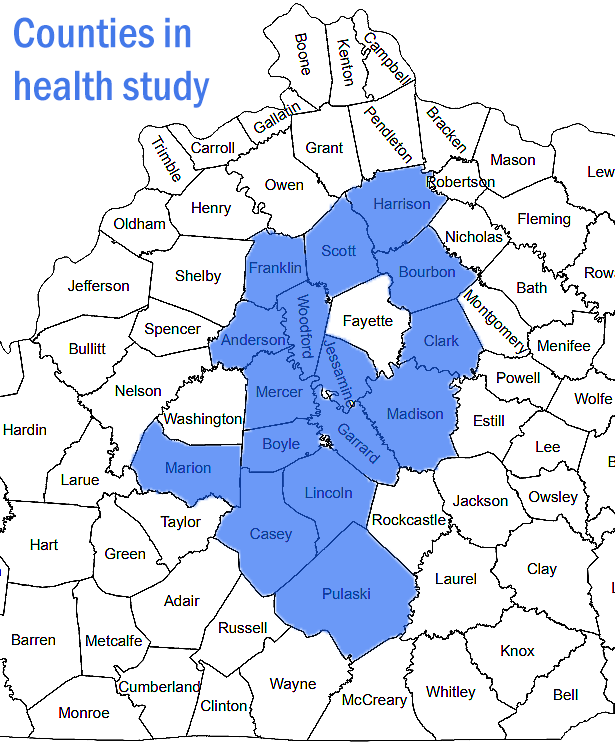
Study to help reduce risk of heart disease and diabetes is looking for participants on Zoom in 16 Central Kentucky counties

Map by Kentucky Health News
By Gia Mudd-Martin
University of Kentucky

Heart disease and Type 2 diabetes are often preventable, but Kentucky has the nation’s ninth-highest rate of heart disease and the fifth highest rate of diabetes. Plus, many Kentuckians have pre-diabetes but don’t know it.

A team of at the University of Kentucky is leading a health study called “Heart of the Family” to help people learn to reduce their risk for these illnesses, and the team is inviting participants to join.

What do participants get?  
  • “Heart of the Family” participants receive eight one-on-one, personalized health education sessions based on their risk factors and health. The sessions are over Zoom — no travel required.
  • Free screenings to check health measurements such as blood pressure and cholesterol; these can be done in your home community (team members can come to you) or at an off-campus UK office
  • Gift card for participation
Who can join? You may be eligible to participate if you are:
  • At least 18 years old
  • Do not have heart disease or diabetes
  • Live in one of these Kentucky counties: Anderson, Bourbon, Boyle, Casey, Clark, Franklin, Garrard, Harrison, Jessamine, Lincoln, Madison, Marion, Mercer, Pulaski, Scott, Woodford
  • Have two or more of these risk factors: family history of heart disease or diabetes; personal history of gestational diabetes or polycystic ovarian syndrome; little or no exercise; unhealthy diet; high blood pressure; high cholesterol; elevated blood sugar; stress; depression; overweight; cigarette smoker
Some participants will be invited to have a friend or family member join with them as a “study buddy,” so make sure you have someone willing to participate with you. They can participate even if they have diabetes or heart disease. Study buddies will receive the same benefits listed above.

What is required of participants? Participants should be willing to complete eight virtual health-education sessions, share health information with the study team, and have blood drawn. All your information will be kept completely confidential, just like in regular medical care.

How can I get involved? If you’re interested in learning more or joining, contact Emily Cravens at emcravens@uky.edu or 859-218-6827. Learn more about participating in research at UKClinicalResearch.com.

Sunday, July 14, 2024

Cigarette tax collections in Ky. dropped after the last two tax increases; the state's smoking rate has also been on the decline

Kentucky Health News graph from state data
By Melissa Patrick
Kentucky Health News

Increasing state cigarette taxes has proven to be an effective policy to decrease smoking rates, and it appears that is also true in Kentucky.

Nearly 30 percent of Kentucky adults smoked in 2011, two years after the legislature had doubled the cigarette tax to 60 cents a pack. Following a 50-cent increase to $1.10 in 2018, the state's adult smoking rate fell to 17.4% in 2022, the last year for which a rate is available. 

Shannon Baker, the American Lung Association's advocacy director for Kentucky and Tennessee, said that while she could not point to something definitive to explain why Kentucky's smoking rate has been decreasing, as has also been the case in the nation, she could speak to the impact of raising cigarette taxes:

"When taxes increase, smoking rates decline. We should take advantage of that, for goodness sake, and increase the cigarette tax in Kentucky by at least $1 and then tax all other nicotine products at parity with the cigarette tax." 

After the initial boost in cigarette-tax revenue from the rate hikes in 2011 and 2018, revenue from the tax declined 24% from 2019 to 2024.

The legislature increased the tax to 30 cents from 3 cents in 2005, but smoking rates before 2011 should not be compared with those after that because of a change in survey methodology, says the Behavioral Risk Factior Surveillance System, a continuing federal-state poll of Americans' habits.

Baker stressed that its important to take advantage of all policies that are known to decrease smoking. Beyond raising taxes, she said it's important to fund the state tobacco-control program and enforce the law against underage sales, which she said would result in fewer youth becoming addicted to nicotine and growing up to be lifelong smokers, and all the health issues that come with that. 

The new report on state General Fund receipts for the fiscal year that ended June 30 showed a 1.5% increase in receipts from other tobacco products, such as electronic cigarettes or vapes.

Asked about the impact of vaping on decreasing smoking rates, Baker focused her comments on yong people, who are more likely to vape than smoke.

"We really have to get a handle on this youth vaping problem," she said, noing that Kentucky is one of about 10 states that doesn't requrie tobacco retailers to be licensed. "We don't even know where all of these shops are in order to enforce the law against underage sales."

Baker added, "We really need a better method of enforcing the law against underage sales. And what that looks like is licensure and routine regular enforcement opportunities that result in significant penalties all the way up to license suspension and revocation, for scofflaws that routinely violate the law. We're not talking about any onerous policy on those who are compliant with the law. We're simply talking about those who violate the law and violate it routinely." 

The 2023 Youth Risk Behavior Survey found that 5.3% of Kentucky high-school students said they currently smoked cigarettes and 19.7% said they used electronic vapor products. Among middle schoolers, the 2.2% said they smoked cigarettes and 12.8% used a vapor product. "Current use" is considered having used a product on at least one day during the 30 days prior to the survey.

Asked if she thought the new law that bans retailers from selling unauthorized vapor products would be effective in decreasing youth vaping, as it has been touted to do, Baker said, "House Bill 11 turned into . . . an industry market-share grab and nothing more; it is not a protection for kids. What we saw was a bill passing that, in effect would, if it's upheld in court, remove certain products, primarily imported products, from the market shelves, which in and of itself is not a bad thing. But, it certainly doesn't protect kids who will just switch to the other products that remain on the shelves." 

The law has been challenged in court. If it holds up, it will go into effect January 2025.

Baker also wanted to make sure people know that the funds for the state's tobacco control program come from the Master Settlement Agreement with cigarette manufacturers, not from the cigarette tax.

"We need to increase funding for tobacco control because . . .  Kentucky has the highest lung-cancer incidence and mortality rates in the entire nation and most of that is due to our high smoking rate," Baler said. "So even though the smoking rate may be declining, it isn't gone. It isn't good, even."

Saturday, July 13, 2024

Kentucky is a national leader in lung-cancer screening, but still has a long way to go to get all eligible people screened

American Cancer Society photo illustration
By Melissa Patrick
Kentucky Health News

Kentucky ranks second among states for lung-cancer screening, but experts say many more Kentuckians need to be screened. Only 10.6% of those at high risk have received screening; the national rate is 4.5%.

A recent study led by American Cancer Society researchers, published in the Journal of the American Medical Association Internal Medicine, shows fewer than one in five eligible individuals in the United States were up-to-date with recommended lung-cancer screening. 

"This research does show an improvement over screening rates reported for previous years. But we clearly, still have a long way to go. We must push harder to move the needle in the right direction,” Dr. Priti Bandi, ACS's scientific director for risk factors and screening-surveillance research, said in a news release.

The U.S. Preventive Services Task Force and ACS recommend annual low-dose CT scans for lung-cancer screening for individuals who:
  • are 50 to 80 years old
  • smoke or have quit smoking within the past 15 years
  • have at least a 20 pack-year smoking history, which means a pack a day for 20 years or two packs a day for 10 years, and so on. A pack year is the number of packs smoked per day multiplied by the number of years the person smoked. 
Jennifer Redmond Knight, who serves as co-principal investigator for the lung-cancer screening project under the Kentucky Lung Cancer, Education, Awareness, Detection, Survivorship Collaborative, said one reasons lung-cancer screening remains low is because it is a relatively new cancer screening. The first recommendations for annual screenings were issued in 2013 and the eligibility for screenings expanded in 2021. 

"What that means is more people are now eligible for screening, which means the percentage of people who have been screened has gone down because there are more people eligible," Knight said. 

Another challenge is stigma, said Knight, who is also an assistant professor in the University of Kentucky's College of Public Health and a member of the UK Markey Cancer Center's Prevention and Control Research Program.

For years, Knight said people with a "significant smoking history" have felt shamed when their health-care providers ask them if they've quit smoking and they haven't, so when their provider encourages this new screening, there are often trust issues.

Knight said much work is being done in Kentucky to reduce stigma associated with lung cancer, largely through the Lung Cancer Screening Program the legislature created in 2022. Knight is on the program's advisory board.

"Kentucky is actually leading the way in many ways with quality lung-cancer screening and addressing the stigmas and helping lung-cancer screening programs throughout the state work in that space," Knight said.

She also talked about the value of early detection, which lets cancer be treated more effectively. Early screening is also important because it can often identify cancer before it spreads or causes symptoms. 

"We have hope now with lung cancer that we never had before," Knight said. "The story used to be if you get lung cancer, you're not going to make it very long. But now there's a story of hope that has to be changed. . . . So there's a lot of cultural shifts around this." 

The cancer society's research found that screening was much less common in persons without health insurance or a usual source of care, and in Southern states, which have the highest lung-cancer burden. Lung cancer is the leading cause of cancer deaths in Kentucky.

Most Kentuckians can pay for lung-cancer screenings through insurance or a program that offers low-cost screenings. Most Kentuckians have access to health insurance because the state expanded Medicaid in 2014, under the Patient Protection and Affordable Care Act, to include people making up to 138% of the federal poverty level. 

"If you meet the eligibility criteria, lung-cancer screening is covered by Medicare, Medicaid and most private insurance plans without cost-sharing. In rare instances where insurance coverage is unavailable, many programs including UK’s Lung Cancer Screening Program, offer screenings at a relatively low cost," Dr. Timothy Mullett of UK wrote in an article to debunk myths about such screenings.

The state Department for Public Health offers a service called Quit Now Kentucky to help Kentuckians of all ages quit smoking. To learn more go to QuitNowKentucky.org, text QUITKY to 797979 or call 1-800-QUIT-NOW.

Lee Co. harm-reduction chief says 80% of clients are homeless

Jo Ann Fraley runs the harm-reduction program for
the Kentucky River District Health Department.
(Photos by Stu Johnson, WEKU)
By Stu Johnson, WEKU

Homelessness is a reality in virtually every section of Kentucky. Although often thought of as an urban challenge, rural Kentucky also finds the plight of the unhoused a pressing issue. Here's a glimpse of how one Appalachian community is addressing homelessness needs.

There is a gathering spot inside The Hub in downtown Beattyville. It’s the Lee County Health Department's harm-reduction center, where staff work to connect clients with care providers.

The director is Jo Ann Fraley, a social worker who’s worked in addiction and recovery. Fraley said about 80 percent of The Hub's clients live on the streets or are couch surfing, and many don’t realize their health status.

“Lot of them have blood-pressure issues and they don’t even know. A lot of them have diabetes and they don’t even know,” Fraley said. “So, those issues we need to address as quick as we can.”

Fraley said the focus is getting people hooked up with doctors and health providers, because “We can’t expect change if we don’t help with the changing process.”

“They’ve lost hope. They give up. They’ve burnt every bridge that they have with family. And so, they let themselves go and they just think nobody cares about them. And whenever someone goes somewhere and they’re not treated very nice, they don’t go back,” said Fraley.

Another staff member at The Hub is Shawn Maynard, who was a user of oxycontin, pain pills, and then methamphetamine, along with alcohol. Maynard has been clean for six years and works with clients to address barriers. He said the homeless lifestyle itself creates health risks.

“When you’re homeless, your hygiene’s not gonna be good and that’s gonna create infection, staph infection,” said Maynard. “If you do get a cut and you’re not getting the proper wound care for it, it’s gonna get infected.”

Nathan Tipton
Nathan Tipton, a client of The Hub, said he’s been four months clean after struggling with drugs for years.

“I was on meth and drinking real bad and after my papa and mama died, it got worse and stayed out there in the woods for about four and half year; still homeless, but life makes a big difference when you got God on your side,” said Tipton.

Tipton said it’s different from before, he was stealing and robbing to get a fix.

The Lee County Health Department is part of the Kentucky River Health District. District Health Director Scott Lockard said he and Fraley brainstormed over The Hub concept, and said creating bonding relationships is important.

“We form that relationship. We show them that they can be treated with dignity. We establish trust and then when the timing is right and they’re ready for treatment, we can link them to treatment immediately,” said Lockard.

“Health is the foundation for everything. If you don’t have health, you can’t worry about education, you can’t worry about employment. You can’t worry about everything else.”

So, Lockard said that means linking up to a medical home and making sure the clients have a payer source, which for most is Medicaid. He said some don’t even realize they are eligible for the fedreal-state program that provides free medical care to lower-income people.

Lockard said the district is trying to to establish a similar program in Letcher County, and he envisions similar like services in all seven Kentucky River District counties, ideally in the next five years or so. Besides Lee and Letcher, the district also includes Knott, Perry, Leslie, Owsley and Wolfe counties.