This is default featured slide 1 title

Go to Blogger edit html and find these sentences.Now replace these sentences with your own descriptions.This theme is Bloggerized by Lasantha Bandara - Premiumbloggertemplates.com.

This is default featured slide 2 title

Go to Blogger edit html and find these sentences.Now replace these sentences with your own descriptions.This theme is Bloggerized by Lasantha Bandara - Premiumbloggertemplates.com.

This is default featured slide 3 title

Go to Blogger edit html and find these sentences.Now replace these sentences with your own descriptions.This theme is Bloggerized by Lasantha Bandara - Premiumbloggertemplates.com.

This is default featured slide 4 title

Go to Blogger edit html and find these sentences.Now replace these sentences with your own descriptions.This theme is Bloggerized by Lasantha Bandara - Premiumbloggertemplates.com.

This is default featured slide 5 title

Go to Blogger edit html and find these sentences.Now replace these sentences with your own descriptions.This theme is Bloggerized by Lasantha Bandara - Premiumbloggertemplates.com.

Sunday, March 13, 2022

Vaccine bills elevating individual rights are moving in legislature

By Melissa Patrick
Kentucky Health News

Bills are moving in both chambers of the General Assembly to loosen immunization rules in Kentucky.

One would ban public entities from asking employees and applicants if they have received a Covid-19 vaccination, and would also ban colleges and universities from requiring students, staff or faculty members to disclose their immunization status. The other would would give a religious exception if any employer requires workers to be immunized against any disease.

Rep. Savannah Maddox (LRC photo)
House Bill 28
, sponsored by libertarian Republican Rep. Savannah Maddox of Dry Ridge, defines a public entity as the state, a local government, or any of their agencies or departments. 

It would also ban public entities from mandating or issuing vaccine passports, passes or other standardized documentations to certify immunization status to a third party for a purpose other than health care, and says such information cannot be published or shared for a purpose other than health care. 

The bill originally applied to all employers. Maddox told the House that she was "personally aggrieved" that she had to take that out of the bill to get it moving. 

"Its initial iteration was designed to ensure that every Kentuckian had the ability to decide for themselves whether or not to receive a vaccine without any type of undue force or coercion from the government, from their employer or from anyone," Maddox said. She added later, "I believe that Kentuckians can make good decisions for themselves when it comes to their health care." 

HB 28 also allows parents or guardians of children in schools to opt them out of any Covid-19 vaccination requirements on the basis of a conscientiously held belief. Kentucky's public schools do not require Covid-19 vaccinations.

Rep. Lisa Willner, D-Louisville, asked why that part of the bill is needed since existing law allows parents to exempt their child from any vaccine required during an epidemic based on conscientiously held beliefs. Maddox said that law pertains to executive mandates related to a state of emergency and applies to everyone, but her bill only pertains to school policies. 

Sentate Bill 8, passed in 2020 without Gov. Andy Beshear's signature, allows several exemptions for "any child or adult" who doesn't want to receive a vaccine that the state mandates during an epidemic, including religious grounds, medical reasons or a "conscientiously held belief." 

Responding to a question from Rep. Pamela Stevenson, D-Louisville, about governments' responsibility to protect the common good and their need for information to do that, Maddox said that while governments need to provide accurate information, it is not their responsibility to mandate vaccines.

She called words and phrases like "protection" or "the government's role to keep people safe . . . euphemisms for forcing a needle into someone's arm against their will. That's what mandatory vaccination is."

Rep. Jennifer Decker, R-Waddy, one of the bill's 26 co-sponsors, said government employers who require employers to disclose their immunization status against their will are practicing government overreach and it is policymakers' responsibility to "protect freedom in our society." 

"After a period of years now that all levels of government have exercised control over people who have longed to be free," Decker said, "this bill is needed."

Minority Caucus Chair Derrick Graham, D-Frankfort, disagreed, saying, "I voted no for the good of the Commonwealth and for local government, the boards of education and the boards in our universities because they need to make those decisions for their students, their community." 

The Kentucky League of Cities opposed the bill, saying it violates home rule of local governments. 

HB 28 passed the House on a 71-22 vote and awaits committee assignment in the Senate. 
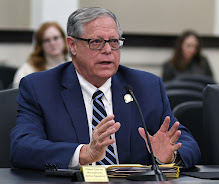
Sen. Rick Girdler (LRC photo)
The religious-exception bill for employees is Senate Bill 93, sponsored by Sen. Rick Girdler, R-Somerset.

"This bill just says on my behalf that we have the right to reject a vaccination based upon our own freedom of religion," he told the Senate Judiciary Committee. "Don't need the church or anybody else. . . . I announced my faith in Jesus Christ wholly on my behalf, and so we will take your word, based upon this bill, that it's against your religion."

The original bill also had an exception for conscientious belief. The committee approved a substitute bill removing that portion. Also, it would put the religious exception in a different section of law to keep it from forming a newly protected class of religious protection, said Sen. Stephen West, R-Paris. 

West noted that Kentucky already allows for medical and religious exceptions to government-required vaccinations, "so this just kind of follows what we already do there." 

The bill also provides that if an employer requires a vaccine, they must provide employees with a one-page sign-off sheet to inform employees of the allowable exceptions.

West noted that the U.S. Supreme Court upheld a federal law that requires health-care workers to be vaccinated for Covid-19 but also allows religious exemptions. He said health-care employers must provide notice to their employees that this exemption exists and have them employees sign off on this notice. 

"In my opinion, this is about personal, individual medical freedom," West said. "The right to choose for yourself if you want to be vaccinated or not vaccinated. And it protects the rights of the individual. But it also provides a framework and some clear guidelines for employers if they want to do the mandate." 

The bill includes a list of health-care providers who would be allowed to provide a written opinion to allow a medical exception for employees, including advanced practice registered nurses, physicians, osteopaths, chiropractors, podiatrists, physician assistants, pharmacists and optometrists.

Sen. Karen Berg, D-Louisville, a physician, objected to including some of those providers: "I just want to make sure that we do limit this to the health-care people who actually would have the knowledge to be able to make this decision."

The bill cleared the Senate Judiciary Committee on an 8-1-1 vote on March 10 and is ready for floor action.


Friday, March 11, 2022

Medical marijuana appears to have more traction than ever in Ky.

Rep. Jason Nemes (CJ photo by Joe Sonka)
Kentucky looks closer than ever to joining the 37 states that allow prescriptions for marijuana, or cannabis.

Thursday evening a state House committee approved a bill that would allow doctors to prescribe cannabis to people who have certain ailments, "along with a new bureaucracy to strictly regulate it from plant to processor to dispensaries," which sponsor Jason Nemes, a Louisville Republican, says will be the strictest medical program in the country," Joe Sonka reports for the Courier Journal.

The ailments are cancer, "chronic, severe, intractable, or debilitating pain; epilepsy or any other intractable seizure disorder; multiple sclerosis, muscle spasms, or spasticity; and nausea or vomiting." Nemes said he will support a floor amendment by Rep. Rona Roberts, D-Covington, to add post-traumatic stress syndrome.

"A similar medical cannabis bill led by Nemes easily cleared the House chamber for the first time in 2020 with 65 votes, but stalled in the Senate because of the Covid-shortened session" and lack of support by Republican leaders, Sonka notes. "However, medical marijuana advocates are now optimistic," due to new support from Senate Judiciary Committee Chairman Whitney Westerfield, "who met many times with Nemes over the past year to amend it into legislation he could back."

Sen. Whitney Westerfield
(Legislative staff photo)
"You can't overestimate how important he is," Nemes said after the House Judiciary Committee approved House Bill 136 15-1. Voting no was Rep. Kim Moser, R-Taylor Mill, who cited opposition from doctors, including concerns about the lack of guidelines for prescribing and dosing cannabis.

Westerfield, a Republican from Crofton in Christian County, said he still has concerns about youth access to cannabis, but “I’ve heard too many stories in my district, and out, from those long suffering, and their loved ones left behind, that marijuana brought comfort and relief when nothing else worked.”

Nemes said "I feel good about where we are in the Senate," but Sonka reports that to pass, the bill would need a majority of the 30 Republicans in that chamber, and the top two Republicans, "Senate President Robert Stivers and Majority Floor Leader Damon Thayer, have both expressed skepticism about medical marijuana in the past and said more research was needed, though the legislation has never received a thorough debate within the chamber's GOP caucus room." Those debates are private.

The bill would allow county governments to impose fees on cannabis businesses "to compensate for any additional public safety impact" and prohibit medicinal cannabis sales by voter referendum, but if a county's voters did so, city governments could exempt themselves from the prohibition.

The bill also includes a 12 percent tax on cannabis sold to dispensers, mainly to cover the costs of regulating it; 13.75% of the revenue would be returned to dispensaries to subsidize purchases of cannabis by those who can't afford it.

Number of Ky. counties where masks are advised is down to 32

Ky. Dept. for Public Health version of CDC map, adapted by Kentucky Health News

Only 32 Kentucky counties have such a high risk of coronavirus infection and hospitalization that residents should wear masks in indoor public spaces, according to the latest weekly ratings by the federal Centers for Disease Control and Prevention.

Most of those counties are in Eastern Kentucky, but include Fayette and four adjoining counties, and Crittenden and Livingston counties in Western Kentucky. Crittenden County has the state's highest rate of new coronavirus cases; Pike County is second, according to CDC data in The New York Times.

Rated at medium risk are 38 counties, where the CDC says residents who are immunocompromised or at high risk for severe illness should talk to a health-care provider about "additional precautions, such as wearing masks or respirators indoors in public. If you live with or have social contact with someone at high risk for severe illness, consider testing yourself for infection before you get together and wearing a mask when indoors with them."

The plurality of counties, 51, are rated at low risk. There, the CDC recommends residents "stay up to date with Covid-19 vaccines and boosters" and "maintain improved ventilation throughout indoor spaces when possible." The ratings are based on new coronavirus cases and Covid-19 hospitalizations.

As a whole, Kentucky ranks fifth in the rate of hospital patients with Covid-19 in the last seven days, and has the nation's eighth highest rate of new cases over that time. Many Kentucky counties are in the Times list of the 100 counties with the highest rates of new cases.

Latest bill to aid independent pharmacies passes first hurdle; would ban requiring or incentivizing patients to use mail order

By Melissa Patrick
Kentucky Health News

Many Kentucky lawmakers keep siding with independent pharmacies against pharmacy benefit managers, the insurance middlemen between pharmacies and drug makers. Thursday a committee approved a bill to ban requiring patients to use mail-order pharmacies or using incentives for mail order.

Rep. Steve Sheldon
"This is truly about the consumer," Rep. Steve Sheldon, R-Bowling Green, told the House Health and Family Services Committee while presenting House Bill 457. Besides Sheldon, its sponsors include 55 of the 100 House members.Pharmacy benefit managers determine what drugs are offered in insurance plans, where and how a patient gets their drugs, how much someone pays for the drug, and how much the pharmacists are paid. 

Sheldon's bill would also ensure that patients can pick their pharmacy, instead of being required to use one affiliated with the PBM, and ban PBMs from retroactively denying a pharmacy claim after adjudication, a process commonly referred to as "clawing back."  

Sheldon said it had taken three years of collaboration to produce this bill, with upwards of 20 organizations supporting it. 

"I'm a legislator. I'm a pharmacist, I serve as a division CEO for a very large self-insured company with several thousand employees, so I'm very sensitive to that issue and how this could affect that. I'm convinced I'm doing what's right for every single one of those," he said, adding that it also addresses the issues for consumers. "I feel like this addresses all four."

The bill also includes language to increase transparency between insurers and PBMs and would halt the a practice of "white bagging," in which a medication must be prepared and distributed by a third-party specialty pharmacy, instead of allowing providers to prepare, administer and bill for the medication. 

Kentucky lawmakers have been working on PBM issues for years, most recently passing 2020 Senate Bill 50 to require the state to hire a single PBM to manage Kentucky Medicaid's prescription-drug business of more than $1 billion a year. A 2019 state analysis found PBMs made $123 million through spread pricing.

Kentucky Pharmacists Association President Cathy Hanna said Sheldon's bill would "ensure Kentuckians have safe, reliable access to the brick-and-mortar community pharmacy of their choice," adding that rural pharmacists "are often the most direct and trusted provider contact for many individuals and families." 

Hanna said requiring patients to get their drugs through mail-order or at a specific PBM-owned pharmacy has contributed to the closing of community pharmacies, saying four have closed in the past month. She cited a recent Public Policy Polling survey that found 84% of respondents did not support mandated mail order.

On the other side of the argument in committee were lobbying groups for PBMs, insurers and some employers.

Conner Rose of the Pharmaceutical Care Management Association, the PBM lobby, said PBMs strive to make drugs affordable and the bill could increase costs. For example, he said employers support "white bagging" because PBMs can provide these expensive drugs at less cost than a provider's office.

“HB 457 continues to include provisions that restrict PBM cost saving tools and therefore will increase prescription drug costs by $213 million in the first year alone," Rose said in an e-mail. 

Frank Jemley, executive director of the Kentucky Association of Manufacturers, expressed concern that the bill would increase health-care costs for Kentucky businesses and manufacturers.  

Scott Brinkman, a former House member and Cabinet secretary representing the Kentucky Association of Health Plans, targeted the contract portion of the bill: "It is invariably a very tricky proposition when government through legislation defines the terms of a contract between two private entities." 

KAHP executive director Tom Stephens said in a statement after the meeting, “I think it’s fair to say that if this government-mandated prescription-drug price-hike bill is passed, the General Assembly will be directly responsible for pricing many Kentuckians out of the market” by removing “cost containment measures that keep health coverage and prescriptions affordable.”

As for community pharmacies, Stephens said, “It’s a solution in search of a problem because Kentucky is in the top five in the nation when it comes to concentration of independent pharmacies.”

Mindy Farnsley, president of the Kentucky Association of Health Underwriters, said the bill "does nothing to address the cost of prescription drugs," would disrupt the health insurance market, and increase employer and consumer premiums.

But the Pharmacists Association said, "The committee's passage of HB 457 brings us one step closer to meaningful reforms that will put an end to PBMs' profit-driven practices that threaten the patient-pharmacist relationship."

Thursday, March 10, 2022

Bill moving in legislature would ban abortions after 15 weeks

Max Wise (Photo by Ryan C. Hermens, Lexington Herald-Leader)
Abortions in Kentucky would be illegal after the 15th week of pregnancy, if the legislature passes a bill that cleared its first hurdle Thursday.

The Senate Judiciary Committee voted along party lines to approve Senate Bill 321, which sponsor Max Wise, R-Campbellsville, said is “closely modeled” after a Mississippi law that awaits a U.S. Supreme Court ruling.

Many legal observers expect the court to uphold the law, setting a new limit for abortions in the U.S. Wise said, “I’m bringing this bill to you so that in the event the Supreme Court upholds the Mississippi legislation . . . we will have a pro-life law in place not subject to a good-faith legal challenge.”

The 2018 legislature passed banned "dilation and evacuation" abortions, which typically take place after 15 weeks, but that law was found unconstitutional under the Supreme Court's 1973 decision that established a right to abortion until the fetus could live on its own, about 23 weeks.

Andy Beshear, then attorney general and now governor, did not appeal the federal district court's ruling, but the high court recently allowed current Attorney General Daniel Cameron to file an appeal. Beshear said yesterday that any laws limiting abortion should have exceptions for cases of rape or incest.

Wise's bill would allow abortion after 15 weeks “to avoid a serious risk of the substantial and irreversible impairment of a major bodily function of the pregnant woman,” or to save her life.

It also "finds and declares according to contemporary medical research" that most abortions after 15 weeks "involve the use of surgical instruments to crush and tear the unborn child apart" and "that the intentional commitment of such acts for nontherapeutic or elective reasons is a barbaric practice, dangerous for the maternal patient, and demeaning to the medical profession."

Dr. Brittany Myers, a Louisville obstetrician-gynecologist, told the committee the bill has “false information and inflammatory language that is focused on shaming and falsely informing the non-medical community,” and said 15 weeks is an arbitrary limit, the Lexington Herald-Leader reports.

Wise's bill says that at 12 weeks, a fetus "can open and close his or her fingers, starts to make sucking motions, senses stimulation from the world outside the womb, and has taken on 'the human form' in all relevant aspects" under the Supreme Court decision upholding the 2003 Partial Birth Abortion Ban Act.

Though Wise's bill depends on the Supreme Court overturning the 1973 decision, the legislature has been "moving ahead as if the landmark law has already been struck down," writes Alex Acquisto of the Herald-Leader. "Over the past six years, Kentucky has not only adopted laws that would make abortion illegal (a 2019 “trigger law” bans abortion immediately if Roe is overturned), and revoke one’s constitutional right to the procedure (Kentuckians will vote on whether to do this in a statewide referendum later this year). But Republican lawmakers have buttressed those laws with a patchwork of other regulations to make the procedure as difficult as possible to access."

House Bill 3, in the Senate Health and Welfare Committee, "would disallow the mailing of abortion pills,' which now are used in most reported Kentucky abortions, "and create a new arduous certification and monitoring program that the Board of Pharmacy says it simply lacks the staff and resources to manage."

Wednesday, March 9, 2022

Must-pass spending bill will let FDA regulate synthetic nicotine, which electronic cigarette makers adopted to avoid regulation

The Puff Bar e-cigarette (Photo by Marshall Ritzel, AP)
The spending bill Congress is passing to keep the federal government going until the fall will let the Food and Drug Administration regulate synthetic nicotine, "which is used in e-cigarettes popular with young people," reports Laurie McGinley of The Washington Post.

"The FDA already has authority over nicotine extracted from tobacco plants. The new legislation would provide the agency with explicit jurisdiction over nicotine made in labs. In the last few years, as the agency has cracked down on e-cigarette makers to curb youth use, some companies, including the popular Puff Bar brand, have switched to synthetic nicotine to avoid regulation."

The FDA gave Puff Bar a big boost in 2020, when it temporarily banned "sweet and fruity e-cigarettes featuring refillable cartridges," McGinley notes. "The restrictions did not apply to Puff Bar’s products because they are not refillable," so "young people flocked to the brand." It was the most popular among high- and middle-school students in a 2021 survey by the FDA and the Centers for Disease Control and Prevention.

The FDA ordered Puff Bars off the market in July 2020, "saying they did not have the needed authorization," McGinley reports. "Last year, Puff Bar reemerged, using a new synthetic nicotine formula that put it beyond the reach of the FDA tobacco regulators. Some other vaping companies took similar steps and still others are considering it, including ones whose marketing applications for tobacco-derived products were rejected by the FDA."

Matthew L. Myers, president of the Campaign for Tobacco-Free Kids, told McGinley, “There has never been a more blatant attempt to circumvent regulation. Some companies announced they were using synthetic nicotine for exactly that purpose.”

Amanda Wheeler, president of American Vapor Manufacturers, which represents companies that make electronic cigarettes and e-liquids, told McGinley, “Like nearly the whole of our industry, we believe synthetic nicotine is a positive innovation that enhances consumer choice and provides a crucial pathway for cigarette smokers to switch to vaping.”

The bill passed the House Wednesday and the Senate is expected to pass it soon. "I’ll be encouraging my colleagues to support this bill," Senate Republican Leader Mitch McConnell said in a press release. "This compromise is not the bill that Republicans would have written on our own. But I am proud of the major concessions we have extracted from this all-Democrat government."

Sixty days after the bill becomes law, the manufacturers would have to apply for FDA authorization, and "Any product not authorized by the agency within 120 days of enactment would become illegal," McGinley reports. "Industry officials said they doubted that the synthetic-nicotine companies would apply to the FDA for permission to sell their products, given that some acknowledged they were striving to avoid FDA regulation. And they questioned whether the firms would have the scientific data necessary to meet the FDA’s standard for granting marketing clearance — that the product be 'appropriate for the protection of public health'."

McGinley notes, "For more than a year, the FDA has been going through the time-consuming task of deciding which vaping products can remain on the market. (Products introduced before August 2016 were given until September 2020 to apply for FDA authorization.) The agency has ordered a halt in sales for a multitude of products but has not acted on the applications of some big players, including Juul. And some of the companies that have been denied marketing authorization are suing the agency."

Tuesday, March 8, 2022

House hopes third bill is the charm as it sends the Senate compromise legislation to address ambulance delays

By Melissa Patrick
Kentucky Health News

The House has passed and sent the Senate a bill aimed at speeding ambulance responses to both emergent and non-emergent transfers.

Rep. Ken Fleming, R-Louisville
House Bill 777, sponsored by Rep. Ken Fleming, R-Louisville, is the third measure on the topic this year, after 13 stakeholders put in more than 1,000 hours of work to reach a compromise. 

"House Bill 777 has been a wild and wooly ride," Fleming said while presenting the bill on the House floor, where it ended up passing 77-15 after little debate.

The Kentucky Hospital Association initiated the legislation, citing a statewide poll that found Kentuckians offered broad support for measures to increase the number of ambulance services in the state.

Fleming commended the work of stakeholders' efforts to find solutions that were in in the best interest of the patients and their quality of care, while also addressing the needs of the industry. 

"This bill basically comes down to this: transporting patients from one point to another," he said, later adding, " "We've got a problem, and 777 is trying to address those timing issues." 

Fleming said he had heard from individuals who waited eight hours to several days for a transfer, and he said a friend's sister died because she was not transported in a timely manner.

Co-sponsor Rep. Kim Moser, R-Taylor Mill, said "This is about strengthening our system, our emergency services in Kentucky. This is not and it should never be about revenue. . . . Our job is to ensure quality patient care."

A key provision in HB 777 would establish a task force to meet between legislative sessions to study emergency medical services and make recommendations to the next General Assembly. It would require the Kentucky Board of Emergency Medical Services to create a special committee to study issues defined in the bill, such as needs of patients with behavioral-health issues.

The bill would also change the certificate-of-need requirements to allow cities, counties and hospitals to transport patients under certain conditions without obtaining a certificate, effectively a license. For example, a hospital could create an ambulance service limited to transporting patients from that hospital.

Rep. Jim DuPlessis, R-Elizabethtown, said picking and choosing groups for different certificate-of-need rules opens the door for others, noting that birthing centers have been asking for this for years. 

HB 777 would also:

  • Require the state health cabinet to investigate and hold hearings regarding complaints related to ambulance services, while leaving disciplinary enforcement to KBEMS;
  • Make it easier for patients to register complaints;
  • Give the cabinet complete and immediate access to all data and records of KBEMS and its contractors;
  • Make KBEMS an independent agency of state government, rather than part of the Kentucky Community and Technical College System;
  • Add KBEMS to the list of boards and commissions for which the Public Protection Cabinet provides administrative services, technical assistance and advice;
  • Exempt organ-procurement organization vehicles from speed limits and traffic-flow patterns while transporting a human organ or tissue in an emergency situation; and
  • Create a Technical Advisory Committee on Emergency Medical Services to advise regarding Medicaid EMS issues.